Dictionary of the active principles of plants: alkaloids : bitter principles; glucosides; their sources, nature, and chemical characteristics / with tabular summary, classification of reactions, and full botanical and general indexes. By Charles E. Sohn.
- Sohn, Charles E.
- Date:
- 1894
Licence: Public Domain Mark
Credit: Dictionary of the active principles of plants: alkaloids : bitter principles; glucosides; their sources, nature, and chemical characteristics / with tabular summary, classification of reactions, and full botanical and general indexes. By Charles E. Sohn. Source: Wellcome Collection.
Provider: This material has been provided by The University of Leeds Library. The original may be consulted at The University of Leeds Library.
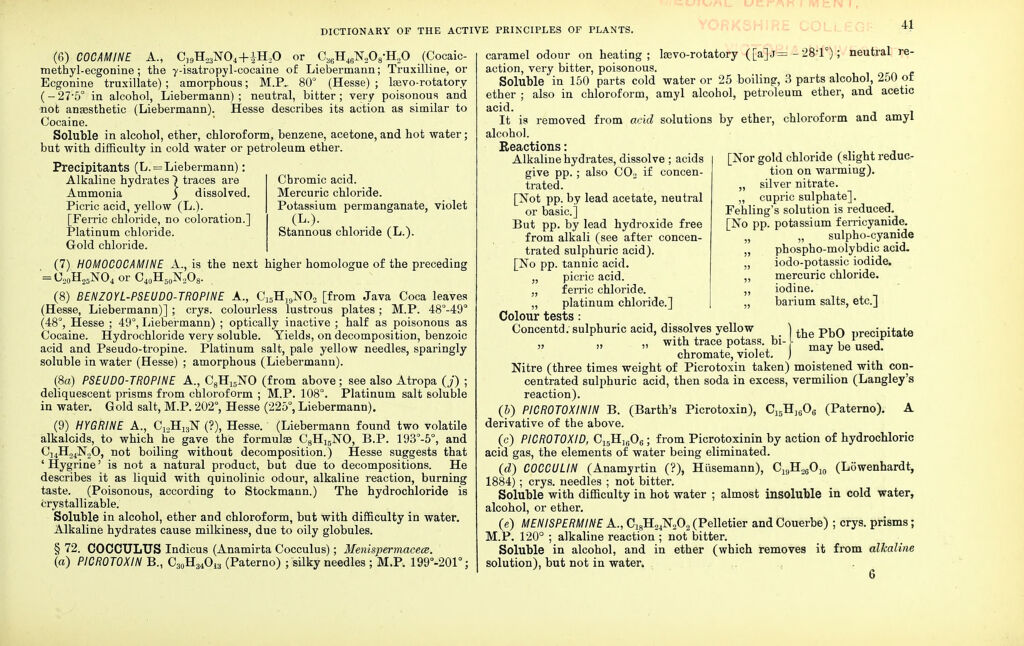
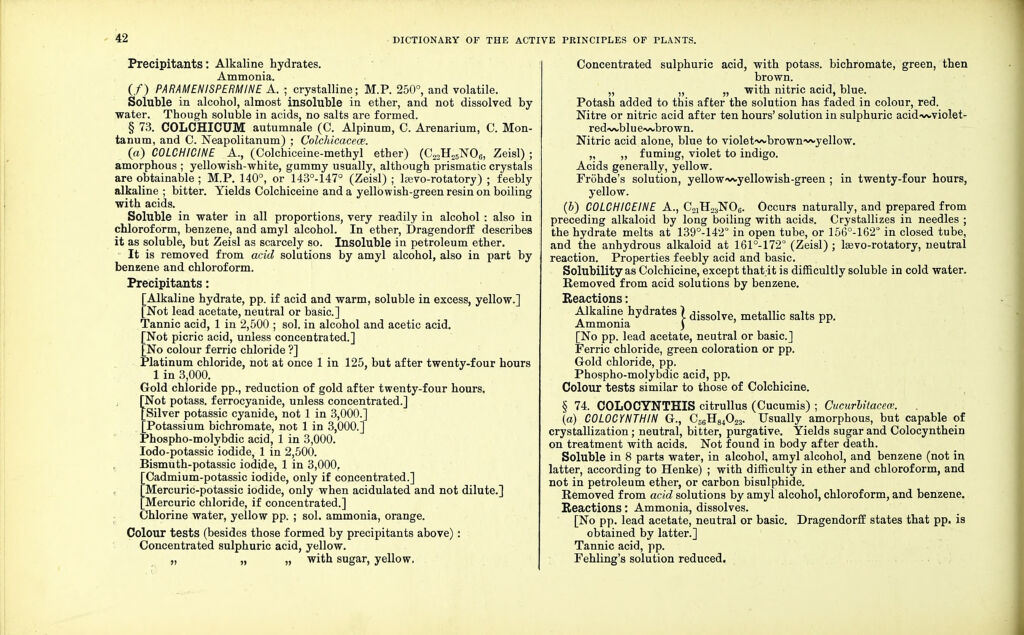
54/210 page 42
![Precipitants: Alkaline hydrates. Ammonia. (/) PARAMEHISPERMINE A. ; crystalline; M.P. 250°, and volatile. Soluble in alcohol, almost insoluble in ether, and not dissolved by water. Though soluble in acids, no salts are formed. § 73. COLCHICUM autumnale (C. Alpinum, C. Arenarium, C. Mon- tanum, and C. Neapolitanum) ; Colchicacece. (a) COLCHICINE A., (Colchiceine-methyl ether) (C22H25N06, Zeisl) ; amorphous ; yellowish-white, gummy usually, although prismatic crystals are obtainable ; M.P. 140°, or 143°-147° (Zeisl) ; lsevo-rotatory) ; feebly alkaline ; bitter. Yields Colchiceine and a yellowish-green resin on boiling with acids. Soluble in water in all proportions, very readily in alcohol : also in chloroform, benzene, and amyl alcohol. In ether, Dragendorff describes it as soluble, but Zeisl as scarcely so. Insoluble in petroleum ether. It is removed from acid solutions by amyl alcohol, also in part by benzene and chloroform. Precipitants: [Alkaline hydrate, pp. if acid and warm, soluble in excess, yellow.] [Not lead acetate, neutral or basic] Tannic acid, 1 in 2,500 ; sol. in alcohol and acetic acid. [Not picric acid, unless concentrated.] [No colour ferric chloride ?] Platinum chloride, not at once 1 in 125, but after twenty-four hours 1 in 3,000. Gold chloride pp., reduction of gold after twenty-four hours. [Not potass, ferrocyanide, unless concentrated.] [Silver potassic cyanide, not 1 in 3,000.] [Potassium bichromate, not 1 in 3,000.] Phospho-molybdic acid, 1 in 3,000. Iodo-potassic iodide, 1 in 2,500. Bismuth-potassic iodide, 1 in 3,000, Cadmium-potassic iodide, only if concentrated.] 'Mercuric-potassic iodide, only when acidulated and not dilute.] Mercuric chloride, if concentrated.] Chlorine water, yellow pp. ; sol. ammonia, orange. Colour tests (besides those formed by precipitants above): Concentrated sulphuric acid, yellow. „ „ „ with sugar, yellow. Concentrated sulphuric acid, with potass, bichromate, green, then brown. „ „ „ with nitric acid, blue. Potash added to this after the solution has faded in colour, red. Nitre or nitric acid after ten hours' solution in sulphuric acid-wviolet- red-»A.blue~vbrown. Nitric acid alone, blue to violet-wbrown^yellow. „ „ fuming, violet to indigo. Acids generally, yellow. Frohde's solution, yellow-v^-yellowish-green ; in twenty-four hours, yellow. (b) COLCHICEINE A., C2iH23N06. Occurs naturally, and prepared from preceding alkaloid by long boiling with acids. Crystallizes in needles ; the hydrate melts at 139°-142° in open tube, or 156°-162° in closed tube, and the anhydrous alkaloid at 161°-172° (Zeisl) ; Isevo-rotatory, neutral reaction. Properties feebly acid and basic. Solubility as Colchicine, except that it is difficultly soluble in cold water. Removed from acid solutions by benzene. Reactions: Alkaline hydrates ) dissolve metallic galts pp. Ammonia ) [No pp. lead acetate, neutral or basic] Ferric chloride, green coloration or pp. Gold chloride, pp. Phospho-molybdic acid, pp. Colour tests similar to those of Colchicine. § 74. COLOCYNTHIS citrullus (Cucumis) ; Cucurbitacece. (a) C0L0CYNTHIN G., C66H84023. Usually amorphous, but capable of crystallization; neutral, bitter, purgative. Yields sugar and Colocynthein on treatment with acids. Not found in body after death. Soluble in 8 parts water, in alcohol, amyl alcohol, and benzene (not in latter, according to Henke) ; with difficulty in ether and chloroform, and not in petroleum ether, or carbon bisulphide. Removed from acid solutions by amyl alcohol, chloroform, and benzene. Reactions: Ammonia, dissolves. [No pp. lead acetate, neutral or basic. Dragendorff states that pp. is obtained by latter.] Tannic acid, pp. Fehling's solution reduced.](https://iiif.wellcomecollection.org/image/b21503023_0054.jp2/full/800%2C/0/default.jpg)