Dictionary of the active principles of plants: alkaloids : bitter principles; glucosides; their sources, nature, and chemical characteristics / with tabular summary, classification of reactions, and full botanical and general indexes. By Charles E. Sohn.
- Sohn, Charles E.
- Date:
- 1894
Licence: Public Domain Mark
Credit: Dictionary of the active principles of plants: alkaloids : bitter principles; glucosides; their sources, nature, and chemical characteristics / with tabular summary, classification of reactions, and full botanical and general indexes. By Charles E. Sohn. Source: Wellcome Collection.
Provider: This material has been provided by The University of Leeds Library. The original may be consulted at The University of Leeds Library.
58/210 page 46
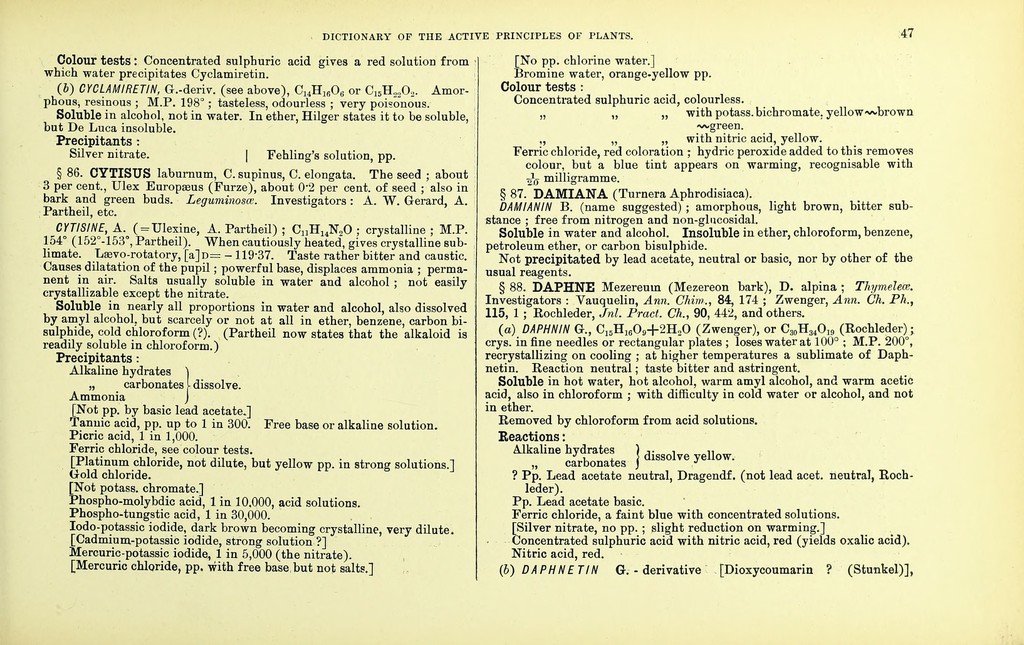
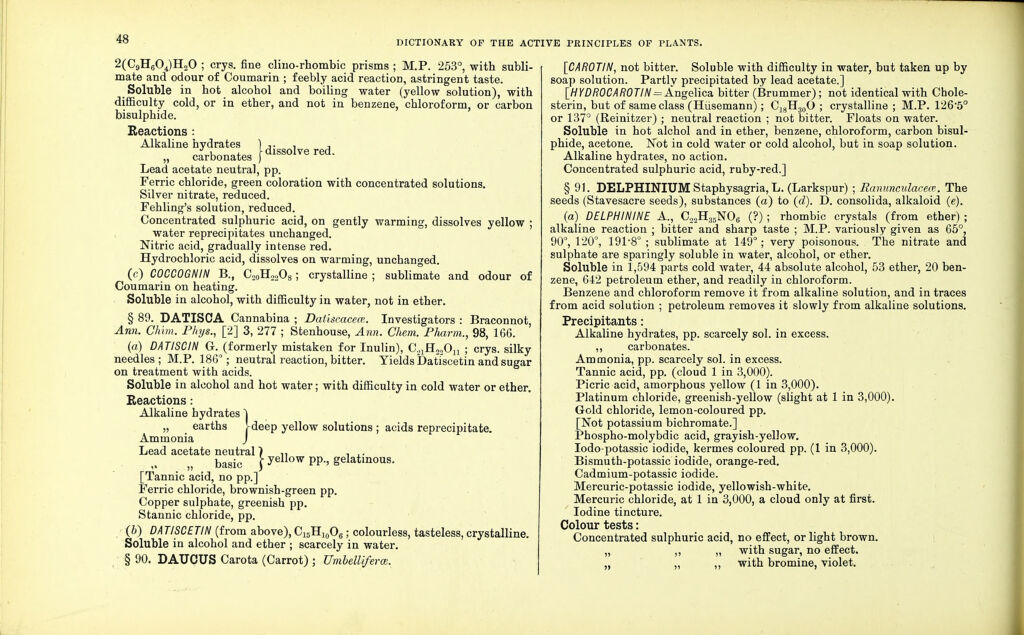
![(c) ADERMANN'S ALKALOID NO. /. C„0H21NO4; M.P. 138°. Optically active ; extracted by ether from acid solution. Isomeric with hydro-berberine (see Berberis), and yielding Berberine on oxidation (disputed by Dobbie and Lauder). (d) ADERMANN'S CORYDALINE [Fumarine ? compare (&)], C22H21N04. An alkaloid resembling Caffeine, and giving following colour tests : Concentrated sulphuric acid, yellow~»violet. „ „ „ with potas. bichromate, colours like those with strychnine. Frohde's reagent, violet, or green streaked with violet. Seleno-sulphuric acid, light violet. (e) Adermann also isolated an amorphous alkaloid. (/) BULBOCAPNINE, A., C34H36N207, compare (b). Freund and Josephy separated this alkaloid, as well as Corycavine, from commercial ' Cory- daline ' (which contained (a) also). M.P. 198°-199° ; dibasic. Precipitated by alkalies ; soluble in excess. (g) CORYCAVINE, A., C23H23N05; M.P. 214°-215°. Less soluble in abso- lute alcohol than is Corydaline. Precipitated by alkalies ; insoluble in excess. § 81. CORYNOCARPUS laevigata (Karaka tree) ; Primulacece; New Zealand. The nut. Investigator: W. Skey, Chemical News, 27, 190 (1873). KARAKIN, G. or B. ; percentage composition, C64.48H4.48031.12 (free from nitrogen). Crystallizes in needles arranged as stars ; M.P. 100° ; feebly acid reaction, bitter, poisonous, producing convulsions. Soluble in alcohol and hot water, with difficulty in cold water, and not in ether or chloroform. It is absorbed by charcoal. Reactions: Alkaline hydrates ) dissolve Ammonia ) [No pp. tannic acid.] Fehling's solution, green pp., with reduction when in certain pro- portions. No pp. Zincic-potassic-sulphocyanide. „ Mercuric-potassic iodide. Concentrated sulphuric acid, dark rose on warming. Acids generally, dissolve. § 82. CRAT.32GUS Oxyacantha (Thorn) ; Rosacea. The bark. Leroy, J. Chim. Med., 17, 3. CRA T/EGIN, B. Grayish white crystals ; bitter. Soluble in water, with difficulty in alcohol, not in ether. i § 83. CREPIS fcetida ; Compositce. Investigator : Walz, N. Jahrb. Pharm., 13, 176. CREPIN; bitter. Soluble in ether. Not precipitated by lead acetate, neutral or basic. § 84. CUOUMIS Melo, Cucurbitaceat. Substance (a). Investigator: Torosiewicz, Repert. Pharm., 45, 30. C. Prophetarum and Ecbalium officinale (which see). Substance (b), Winckler, N. Jahrb. Pharm., 11,31. (a) MELONEMETIN, B. Brown amorphous, emetic. Soluble in water and alcohol, not in ether. (b) PROPHETIN, G., C20H36O7 ? Resinous, white amorphous, bitter. Acids produce prophetein and sugar. Soluble in alcohol in almost all proportions, also in ether, with diffi- culty in water. Precipitated by tannic acid. [Not by lead acetate, neutral or basic] Concentrated sulphuric acid, reddish-brown. §85. CYCLAMEN Europseum; Primula veris (small quantity in root); Anagallis arvensis (very small quantity) ; Limosella aquatica. Primulacece. Investigators : Saladin, Journ. Chim. Med., 6, 417 ; Martius, N. Repert. Pharm., 8, 388 ; Hilger and Mutschler, Ann. Chem. Pharm., 185, 214, and others. (a) CYC LAM IN, G., (Primulin, Arthanitin), C20H34O10 or C36H66Oie (G. Michaud), crystalline (Saladin), or amorphous (De Luca); M.P. 236° ; neutral reaction ; sharp taste ; feebly Isevo-rotatory. The powder causes sneezing. Acids give Cyclamiretin and sugar. Resembles Saponin. Soluble in water after exposure to moist air; the solution is frothy; dissolved also by methyl and amyl alcohols, acetic ether, glycerine; sparingly in absolute alcohol (Mutschler gives solubility for 96 per cent, alcohol, 1 in 71). Insoluble in ether, chloroform, benzene, petroleum ether, or carbon bisulphide. Precipitants: Lead acetate, neutral. Fehling's solution, white pp., no I Silver nitrate. cuprous oxide formed. Copper sulphate. [No pp. Cadmium-potassic iodide.]](https://iiif.wellcomecollection.org/image/b21503023_0058.jp2/full/800%2C/0/default.jpg)