Dictionary of the active principles of plants: alkaloids : bitter principles; glucosides; their sources, nature, and chemical characteristics / with tabular summary, classification of reactions, and full botanical and general indexes. By Charles E. Sohn.
- Sohn, Charles E.
- Date:
- 1894
Licence: Public Domain Mark
Credit: Dictionary of the active principles of plants: alkaloids : bitter principles; glucosides; their sources, nature, and chemical characteristics / with tabular summary, classification of reactions, and full botanical and general indexes. By Charles E. Sohn. Source: Wellcome Collection.
Provider: This material has been provided by The University of Leeds Library. The original may be consulted at The University of Leeds Library.
59/210 page 47
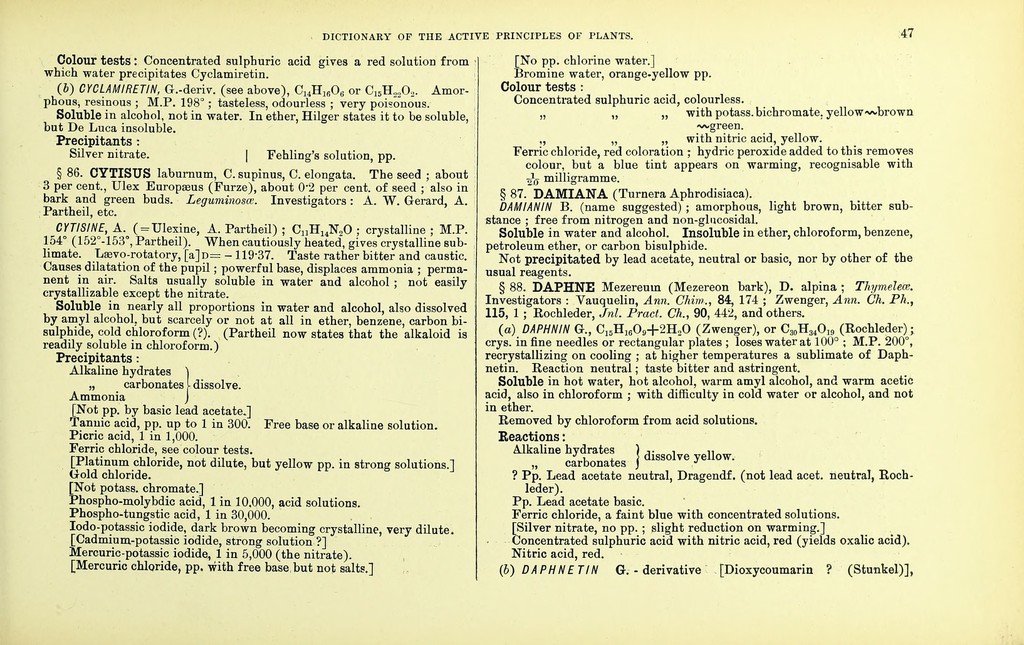
![Colour tests: Concentrated sulphuric acid gives a red solution from which water precipitates Cyclamiretin. (6) CYCLAMIRETIN, G.-deriv. (see above), C14H1606 or CI5H2202. Amor- phous, resinous ; M.P. 198°; tasteless, odourless ; very poisonous. Soluble in alcohol, not in water. In ether, Hilger states it to be soluble, but De Luca insoluble. Precipitants : Silver nitrate. | Fehling's solution, pp. § 86. CYTISUS laburnum, C. supinus, C. elongata. The seed ; about 3 per cent., Ulex Europseus (Furze), about 0-2 per cent, of seed ; also in bark and green buds. Leguminosce. Investigators: A. W. Gerard, A. Partheil, etc. CUISINE, A. ( = TJlexine, A. Partheil) ; C„HuN„0 ; crystalline ; M.P. 154° (152°-153°, Partheil). When cautiously heated, gives crystalline sub- limate. Lasvo-rotatory, [a]n= -119-37. Taste rather bitter and caustic. Causes dilatation of the pupil; powerful base, displaces ammonia ; perma- nent in air. Salts usually soluble in water and alcohol ; not easily crystallizable except the nitrate. Soluble in nearly all proportions in water and alcohol, also dissolved by amyl alcohol, but scarcely or not at all in ether, benzene, carbon bi- sulphide, cold chloroform (?). (Partheil now states that the alkaloid is readily soluble in chloroform.) Precipitants: Alkaline hydrates \ „ carbonates I dissolve. Ammonia j [Not pp. by basic lead acetate.] Tannic acid, pp. up to 1 in 300. Free base or alkaline solution. Picric acid, 1 in 1,000. Ferric chloride, see colour tests. [Platinum chloride, not dilute, but yellow pp. in strong solutions.] Gold chloride. [Not potass, chromate.] Phospho-molybdic acid, 1 in 10,000, acid solutions. Phospho-tungstic acid, 1 in 30,000. Iodo-potassic iodide, dark brown becoming crystalline, very dilute. [Cadmium-potassic iodide, strong solution ?] Mercuric-potassic iodide, 1 in 5,000 (the nitrate). [Mercuric chloride, pp. with free base but not salts.] [No pp. chlorine water.] Bromine water, orange-yellow pp. Colour tests : Concentrated sulphuric acid, colourless. „ „ „ with potass, bichromate, yellow-wbrown ~vgreen. ,, „ „ with nitric acid, yellow. Ferric chloride, red coloration ; hydric peroxide added to this removes colour, but a blue tint appears on warming, recognisable with milligramme. § 87. DAMIANA (Turnera Aphrodisiaca). DAMIANIN P>. (name suggested) ; amorphous, light brown, bitter sub- stance ; free from nitrogen and non-glucosidal. Soluble in water and alcohol. Insoluble in ether, chloroform, benzene, petroleum ether, or carbon bisulphide. Not precipitated by lead acetate, neutral or basic, nor by other of the usual reagents. § 88. DAPHNE Mezereuin (Mezereon bark), D. alpina ; Thymelece. Investigators : Vauquelin, Ann. Chim., 84, 174 ; Zwenger, Ann. Ch. Ph., 115, 1 ; Rochleder, Jnl. Pract. Ch., 90, 442, and others. (a) DAPHNIN G., C15H1609+2H„0 (Zwenger), or C30H34Oi9 (Rochleder); crys. in fine needles or rectangular plates ; loses water at 100° ; M.P. 200°, recrystallizing on cooling ; at higher temperatures a sublimate of Daph- netin. Reaction neutral; taste bitter and astringent. Soluble in hot water, hot alcohol, warm amyl alcohol, and warm acetic acid, also in chloroform ; with difficulty in cold water or alcohol, and not in ether. Removed by chloroform from acid solutions. Reactions: Mkaline hydrates j disgolye u „ carbonates ) J ? Pp. Lead acetate neutral, Dragendf. (not lead acet. neutral, Roch- leder). Pp. Lead acetate basic. Ferric chloride, a faint blue with concentrated solutions. [Silver nitrate, no pp. ; slight reduction on warming.] Concentrated sulphuric acid with nitric acid, red (yields oxalic acid). Nitric acid, red. (6) DAPHNE TIN G. - derivative [Dioxycoumarin ? (Stunkel)],](https://iiif.wellcomecollection.org/image/b21503023_0059.jp2/full/800%2C/0/default.jpg)