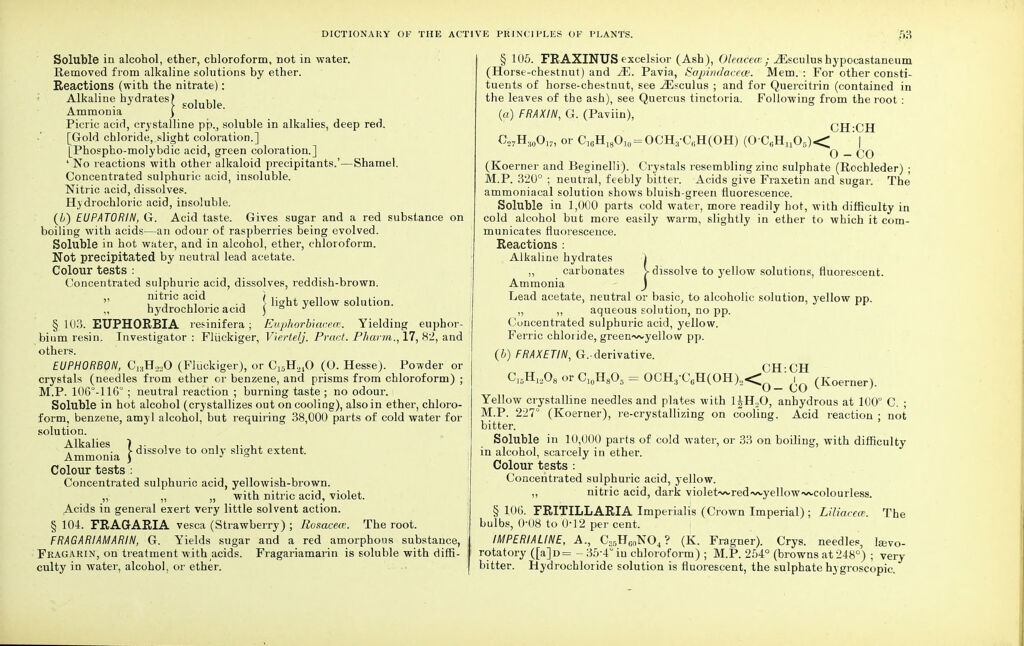
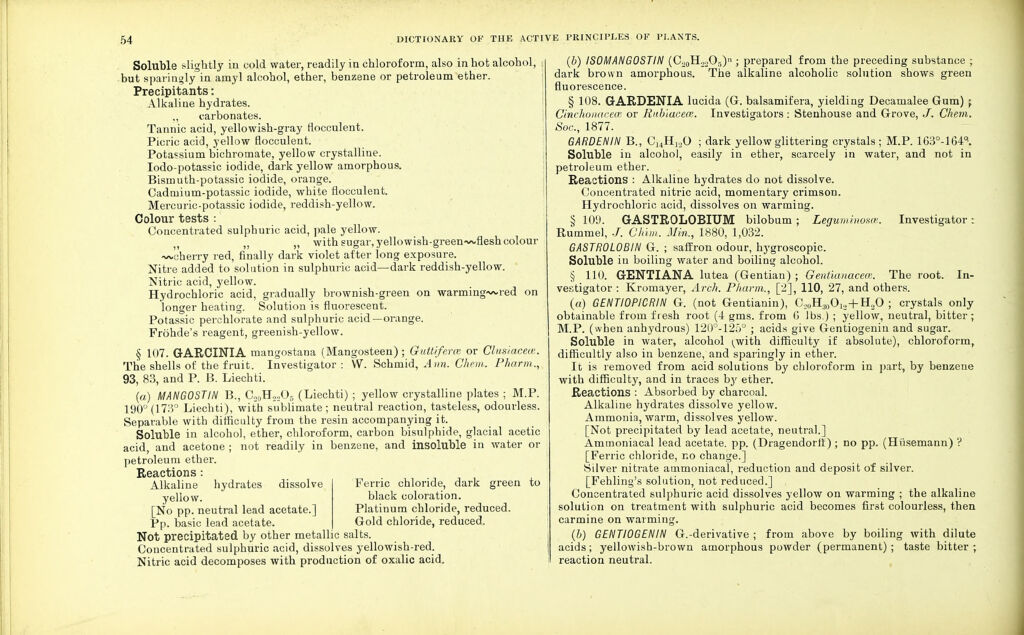
Dictionary of the active principles of plants: alkaloids : bitter principles; glucosides; their sources, nature, and chemical characteristics / with tabular summary, classification of reactions, and full botanical and general indexes. By Charles E. Sohn.
- Sohn, Charles E.
- Date:
- 1894
Licence: Public Domain Mark
Credit: Dictionary of the active principles of plants: alkaloids : bitter principles; glucosides; their sources, nature, and chemical characteristics / with tabular summary, classification of reactions, and full botanical and general indexes. By Charles E. Sohn. Source: Wellcome Collection.
Provider: This material has been provided by The University of Leeds Library. The original may be consulted at The University of Leeds Library.
63/210 page 51
![Reactions : [Not precipitated by lead acetate neutral or basic] Pp. Tannic acid. § 94. ECHUGrIN poison, from Adenium Boehmianum ; Apocynacece ; Africa. Investigator : R. Boehm, 1889. ECHUGIN G. (about 10 per cent, of the poison) ; crys. silky rhombic plates ; bitter, cardiac poison. Soluble in water and alcohol ; not in ether. § 95. ELEMI resins (from Canarium, Icica, etc.) ; Amyridacece. (The two following substances are included here for convenience of reference, but do not belong to the groups under treatment.) (a) AMYRIN, 2(C10H16)H2O (Fliickiger) ; crystalline; M.P. 177° with sublimate. Soluble in alcohol (27 parts), and in ether, chloroform, carbon- bisulphide. (&) BRYOIDIN (Baups' Brei'din ; distinct from Bryonin, see Bryonia). 2(O10H16)3H2O (Fliickiger) ; prismatic crystals ; M.P. 135°, with subli- mate. Soluble in alcohol, ether, chloroform, acetic acid, and glycerine. Dry hydrochloric acid gas gives red-wvviolet-wgreen. § 9G. EPHEDRA monostachia and E. vulgaris, var. Helvetica ; Gne- tacece. Investigators : Nagai, Spehr. (<s) EPHEDRINE A. (the alkaloids so named, by Nagai and Spehr respec- tively, do not agree in properties ; they are here described together, Ng. referring to Nagai's base, and Sp. to that of Spehr), C1(1H15NO (Ng.), or C^H^NO (Sp.) ; taste bitter (Ng.), burning (Sp.) ; M.P. 21(J° (Ng.), 112° (Sp.). Soluble with difficulty in water, Ng. (very soluble, Sp.) ; readily in alcohol, Ng., Sp.; in chloroform easily, Ng., Sp. (1 in 11, Sp.) ; in ether easily, Ng. (1 in 98, Sp.) ; in benzene easily, Ng. (1 in 1,180, Sp.). (b) PSEUD0-EPMEDR1NE A., C10H15NO (Nagai) ; M.P. 115°; bitter. Soluble readily in alcohol, in 15 parts ether, 2G benzene ; with difficulty in water. § 97. ERGOT of rye (Secale cornutum ; Claviceps purpurea, Tulasne ; Scierotium clavus, D.C. ; Spermoeiia clavus, Fries) ; Fungi. Investigators, numerous. In addition to the alkaloids described below, the following substances have been found in Ergot : Scleromucia (2 to 3 per cent.), Sclerotic Acid (1 to 4 per cent.), Cholesterin, Mycose, Mannite, Leucine, Methyl-, and Trimethyl-amine. Several colouring matters have been isolated by Dragendorff (Dorpat. Naturf. Gesell, 4, 392), viz. : Scler-erythrin, Picro- sclerotin, Fusco-sclerotic Acid, Sclero-xanthin, and Sclero-crystallin. For Vernine, also present, see Vicia sativa. (a) ERGOTINE A., CMH5.,N,0., (Wenzell, Amer. J. Pharm., 35, 193) ; amorphous, alkaline, feebly bitter ; salts amorphous. Soluble in water and alcohol ; not in ether or chloroform. Precipitants : [Not lead acetate, neutral.] Tannic acid. [Platinum chloride, in an alcoholic+ether solution.] Gold chloride. [Not potass, cyanide.] Phospho-molybdic acid, separated by this means from tiimethylamine, which is not precipitated. Mercuric chloride, but not in acid solutions (see Ecboline). (b) ECBOLINE A. ■ amorphous, alkaline, slightly bitter. Salts amorphous. Soluble in water and alcohol ; not in ether or chloroform. Precipitants: Potass, cyanide, white. Phospho-molybdic acid. Mercuric chloride, in acid solu- tion (see Ergotine above). [Not lead acetate, neutral.] Tannic acid. Platinum chloride, yellow. Gold chloride. Colour tests : Concentrated sulphuric acid, dark red (c) ERGOTININE A. (Tanret:s), C35H40N4O6; fluorescent, crystalline, slightly bitter. Salts readily decompose. Acid solutions gradually redden. Alkalies evolve Methylamine. Soluble in alcohol (becoming green, then brown), also in chloroform and ether (but with difficulty in the latter after exposure) ; not in water. It is removed from acid solutions by ether and chloroform. Precipitants: Tannic acid. Platinum chloride. Gold chloride. Phospho-molybdic acid. Iodo-potassic iodide. Mercuric-potassic iodide. [Not mercuric chloride.] Bromine water.](https://iiif.wellcomecollection.org/image/b21503023_0063.jp2/full/800%2C/0/default.jpg)