Dictionary of the active principles of plants: alkaloids : bitter principles; glucosides; their sources, nature, and chemical characteristics / with tabular summary, classification of reactions, and full botanical and general indexes. By Charles E. Sohn.
- Sohn, Charles E.
- Date:
- 1894
Licence: Public Domain Mark
Credit: Dictionary of the active principles of plants: alkaloids : bitter principles; glucosides; their sources, nature, and chemical characteristics / with tabular summary, classification of reactions, and full botanical and general indexes. By Charles E. Sohn. Source: Wellcome Collection.
Provider: This material has been provided by The University of Leeds Library. The original may be consulted at The University of Leeds Library.
67/210 page 55
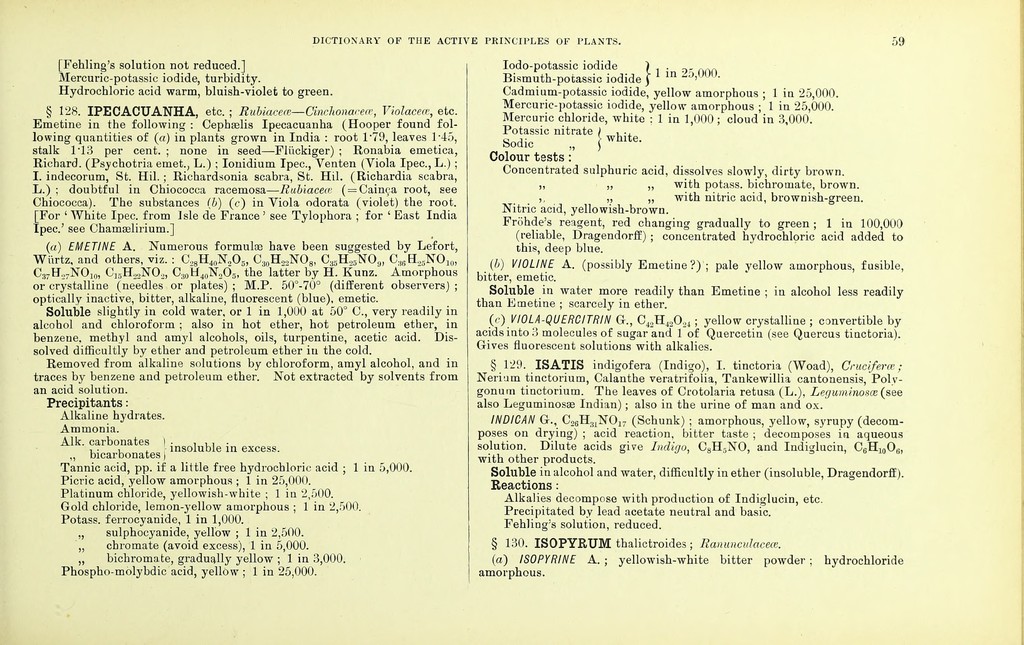
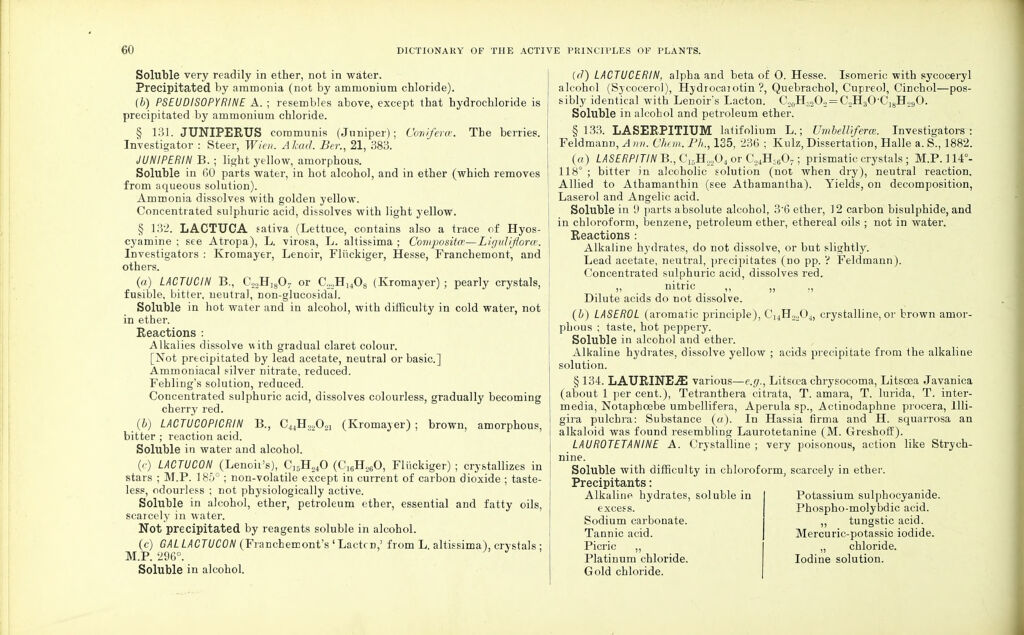
![Soluble in alcohol and in a mixture of ether with alcohol, but diffi- cultly in water. (c) GENTIANIN (gentianic acid; Gentisin), CuHl0O6=Ci3H5O2(OGH3) (OH)2 ; yellow crystals, neutral reaction, not bitter. Soluble scarcely in water, and with difficulty in alcohol or ether. Alkalies give red coloration. {d) GENTISEIN = Gentisin less 1 methyl group = C13H805; yellow crystals; acids give deep red precipitates: dyes wool yellow (with alumina mordant). § 111. GETJM urbanum ; Rosacea. Investigator: Buchner, He pert. Pharm., 85, 184. GEUM BITTER ; amorphous, yellow, neutral. Soluble in alcohol and ether, with difficulty in water. Forms compounds with potash, lime and lead oxide that are soluble in alcohol. Dissolved by alkalies. § 112. GLEDITSCHIA triandra ; Leguminosce. GLEDITSCHINE A. ; resinous amorphous powder. Soluble in alcohol, not in water. Salts crystalline. § 113. GLOBULARIA alypum ('Wild Senna' of Germany), Sela- ginacew. Investigators : Walz, N. Jahrb. Pharm., vols. 7 and 13; Heckel and Schlagdenhauffen, Ann. Chim. Phys., [5], 28, 67. (a) GLOBULARIM G., C,0H44O14 (Walz), or C15Ho008 (Heckel and Schlag- denhauffen) ; amorphous, bitter, neutral powder. Acids give rise to sugar and Globularetin, C12HJ403 (Walz), or C9H60 (Schlagdenhauffen) ; a substance yielding cinnamic acid on decomposition. Globularin is soluble in water and alcohol, but not in ether. Precipitated by tannic acid. Globularesin (not the derivative of Globularin) is an agreeable smelling resin. § li4. GLYCYRRHIZA glabra (Liquorice), G. echinata, Chryso- phyllum glycyphlceum ; Leguminosm—Papilionacece ; also in Juglans regia (walnut). GLYCYRRHIZIN; C44H63NOi8 (an acid ammonium salt of Glycyrrhizic acid); prismatic needles from glacial acetic acid solution; M.P. 200°; optically inactive, acid reaction, bitter-sweet taste. Soluble in hot water (gelatinous cold), in alcohol (sparingly if abso- lute), and in warm ether (Dragendorff says almost insoluble). Reactions: Alkalies dissolve reddish-yellow, with characteristic odour. Ammonia, reddish-yellow solution. Lead acetate, neutral or basic, precipitates (the alcoholic solution). Salts of heavy metals give pp. (Habermann). [Cadmium-potassic iodide, no pp.] Sulphuric acid, precipitates from aqueous solution. § 115. GONOLOBUS condurango ; Asclepiadaceee. The bark. In- vestigators : G. Carrara, see J. Ch. Soc, 91, 1387; also Vulpius. (A wax C30H50O2, M.P. 52°, and Cinnamic acid are also present.) G0N0L0BIN G. (Carrara's Glucoside), C40H74Ofi ; yellow powder ; M.P. 112°. Soluble slightly in water and alcohol ; not in ether or petroleum ether. Not precipitated by iodo-potassic iodide or mercuric-potassic iodide. Another glucoside apparently also present, but details as yet dis- cordant. § 116. GRATIOLA officinalis (Hedge Hyssop) ; Scrophulariacem. In- vestigator : Walz, Jahrb. Pharm., vols. 14, 21, 24 ; and N. Jahrb. Pharm., vol. 10. (a) GRATIOLIN G., C4.,Hi(1014 or C4nH:j4Ou ; crys. needles from water; M.P. 200° without change ; bitter, poisonous (slows heart's action). Acids split into Gratioletin, Gratiolaretin, and sugar. Soluble in 893 parts cold water or 476 boiling, in alcohol, chloroform, benzene, and in 1,000 parts cold or 666 boiling ether. It is removed from acid aqueous solutions by chloroform and benzene, but not by ether. Reactions: Ammonia dissolves (water reprecipitates). [Not precipitated by lead acetate, neutral or basic] Precipitated by tannic acid. Colour tests: Concentrated sulphuric acid, orange->/vbrown~<-red at edges (water re- precipitates). Concentrated nitric acid, yellow (water reprecipitates). (b) GRATIOSOUN G, C18H16O10 or C46H42O20 ; red or yellow powder; amorphous or crystalline ; M.P. 125° : bitter, with characteristic odour ;](https://iiif.wellcomecollection.org/image/b21503023_0067.jp2/full/800%2C/0/default.jpg)