Dictionary of the active principles of plants: alkaloids : bitter principles; glucosides; their sources, nature, and chemical characteristics / with tabular summary, classification of reactions, and full botanical and general indexes. By Charles E. Sohn.
- Sohn, Charles E.
- Date:
- 1894
Licence: Public Domain Mark
Credit: Dictionary of the active principles of plants: alkaloids : bitter principles; glucosides; their sources, nature, and chemical characteristics / with tabular summary, classification of reactions, and full botanical and general indexes. By Charles E. Sohn. Source: Wellcome Collection.
Provider: This material has been provided by The University of Leeds Library. The original may be consulted at The University of Leeds Library.
69/210 page 57
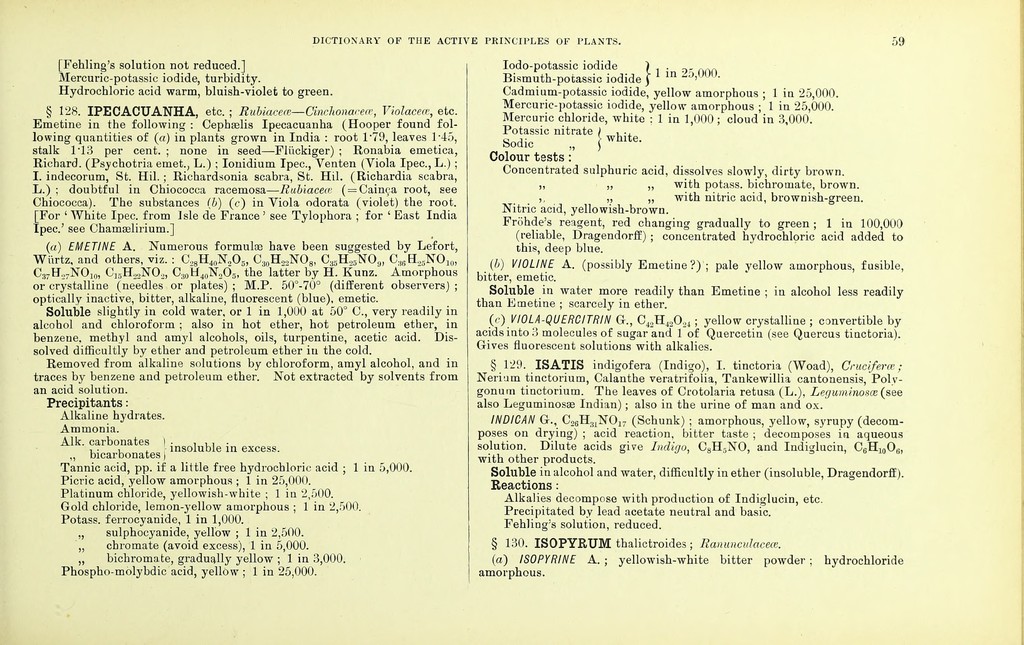
![HELIOTROPINE A. (the Cynoglossine of Buchheim); rhombic crystals, volatile, alkaline, bitter, poisonous. Salts become brown on exposure. Soluble in water and ether. Reactions: Alkalies, oily pp. Precipitated by most alkaloid reagents. Concentrated sulphuric acid, yellow changing slowly to red. § 121. HELLEBORUS niger, H. viride, H. foetidus; Ranunculacece. (For White Hellebore, see Veratrum.) Investigators : Husemann and Marmt', Ann. Chem. Pharm., 135, and others. (a) HELLEBOREIN G., C26H440i.5 (Husemann) ; crystallizes in fine needles from alcohol; semi-fusion at 280°; deliquescent, faintly acid reaction, sweetish taste, poisonous. Acids give Helleboretin and 2 molecules sugar. Soluble in water, alcohol (not as easily as in water), chloroform; not in ether. It is removed from acid solutions by chloroform, but not by benzene or petroleum ether. Reactions: [Alkaline hydrates, no effect.] [No pp. basic lead acetate.] Tannic acid, pp. [No pp. or coloration Ferric chloride.] [No pp. platinum chloride or cupric sulphate.] Phospho-molybdic acidl ,, tungstic acid ) PP Concentrated sulphuric acid, brownish-red with trace of violet. (b) HELLEBORETIN G.-deriv., C]4H20O;i; amorphous dark blue flocks, drying to a gray powder ; no physiological action ; tasteless, neutral. Soluble in alcohol (violet solution), scarcely in ether, not in water. Concentrated sulphuric acid, brownish-red. (c) HELLEBORIN G., C36H4.,0G ? (Husemann); found in traces only; crystalline needles; M.P. above 250°; neutral reaction, burning taste (when dissolved in alcohol). Partly converted by acids, and completely by zinc chloride, into Helleboresin and sugar (one molecule). Soluble in hot water when in presence of Helleborein, also in alcohol and chloroform, but with difficulty in cold water, ether, or fatty oils. Meta-tungstic acid, pp. [No pp. iodo-potassic iodide. „ cadmium-potassic iodide. ,, mercuric-potassic iodide. ,, mercuric chloride. Millon's reagent / Mercurous nitrate \ PP' [No pp. other metallic salts.] Concentrated sulphuric acid, blood-red ; water precipitates white flocks. (d) HELLEBORESIN G.-deriv., C30H;i8O4 (?) ; amorphous grayish powder; softens at 140° ; neutral, tasteless. Soluble in alcohol, scarcely in ether, not in water. § 122. HUMULUS Lupulus (Hop) ; Cannahinacece. The cones, and in particular the Lupulinic granules. Investigators, very numerous; men- tion may be made of Ives (1821), Pay en and Chevalier, Personne, Doebereiner, Lermer, Etti, Issleib, Bungener, Lintner, Greshotf, Hay- duck. Notwithstanding so many investigations, there is still uncertainty as to the bitter principles of the hop. (I have given a short resume in my paper on ' Hops and Bitter Principles,' published by the Science Society of the City of London College, reprinted in other periodicals, including the Allgemeine Brauer. u. Hop/en Ze/tung, Nuremberg.) The following embodies the results.of the most recent researches (those of the last four chemists enumerated above) : (1) LUPULINIC ACID (Hop-bitter Acid, Hopfenbittersaure, Lermer's bitter principle); crystalline; M.P. 56°; free from nitrogen; per- centage composition, C 67'8G to 6'J, H 8 to 8-7 (Lintner and Bungener); acid reaction, bitter (in alcohol). Soluble in alcohol and ether, not in water. Lintner and Bungener have separated this substance from the Alpha- resin of Hayduck, and the latter finds that it yields substances resembling the Alpha- and Beta-resins on oxidation. (2) ALPHA-RESIN (Hayduck's) ; soft tenacious, light reddish-brown, almost odourless, intensely bitter, feebly acid in character. Soluble in alcohol, ether, chloroform, petroleum ether, slightly in water. Removed from add solutions by immiscible solvents. Reactions: Alkaline hydrates dissolve with a darkening of colour. Lead acetate neutral, alcoholic solution, yellow pp., soluble in excess. ,, ,, ,, aqueous ,, white pp. Ferric chloride (aqueous), brown pp. Copper acetate (alcoholic), green pp., supernatant fluid green ; the copper compound is soluble in alcohol, ether, chloroform, benzene, and to some extent in petroleum ether. Copper acetate (aqueous), bluish-white pp. ; on shaking with ether, the latter is coloured green. (3) BETA-RESIN (Hayduck's) ; closely resembles the preceding, but is 8](https://iiif.wellcomecollection.org/image/b21503023_0069.jp2/full/800%2C/0/default.jpg)