Dictionary of the active principles of plants: alkaloids : bitter principles; glucosides; their sources, nature, and chemical characteristics / with tabular summary, classification of reactions, and full botanical and general indexes. By Charles E. Sohn.
- Sohn, Charles E.
- Date:
- 1894
Licence: Public Domain Mark
Credit: Dictionary of the active principles of plants: alkaloids : bitter principles; glucosides; their sources, nature, and chemical characteristics / with tabular summary, classification of reactions, and full botanical and general indexes. By Charles E. Sohn. Source: Wellcome Collection.
Provider: This material has been provided by The University of Leeds Library. The original may be consulted at The University of Leeds Library.
74/210 page 62
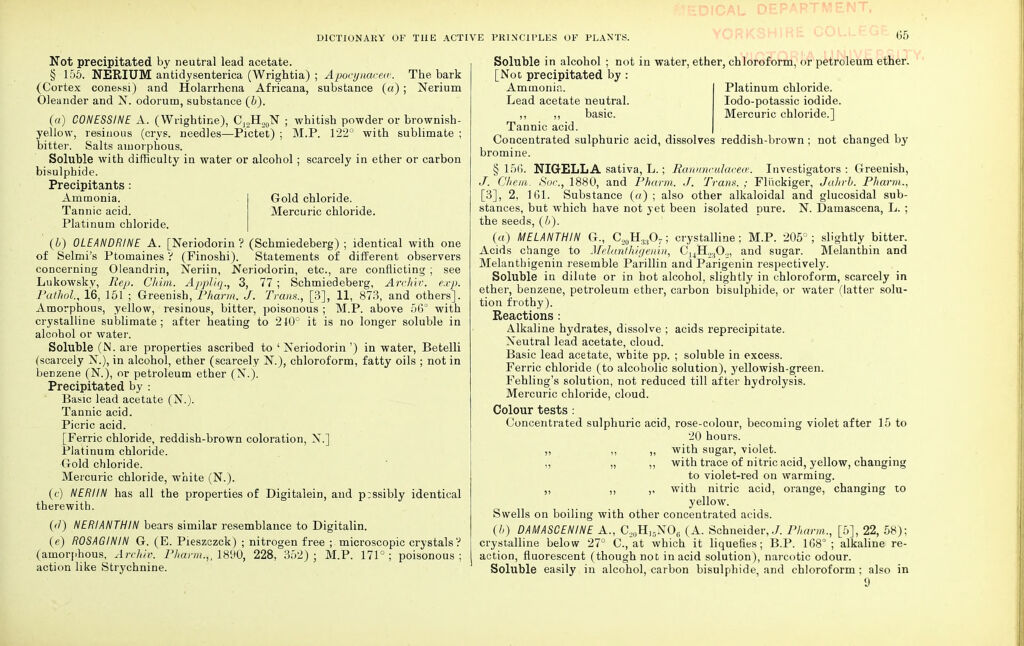
![Hydrochloric acid hot, gives rise to a green substance. § 140. LOBELIA inflata L. ; Campanulaceic. Investigators : F.Mayer, Viertelj. pract. Pharm., 15, '233 ; Lewis, Pharm. J., Trans., [3], 8, 561. (a) LOBELIINE A.-G.° (Lobelina) ; oily yellowish-white, alkaline, taste acrid. Yields sugar on long boiling. Salts crystalline (not the acetate). Soluble in water (with yellow colour), in alcohol, amyl alcohol, chloro- form, ether (the best solvent), benzene, petroleum ether, carbon bisulphide, fatty and essential oils. Contrary to the behaviour of substances of its class, it is removed from acid solution by petroleum spirit and chloroform. Precipitants: [Alkaline hydrates, decomposs with production of substance having aromatic odour.] Ammonia, white pp. Lead acetate, neutral, white needles (no pp. '?). ., ,, basic (no pp. ?). Tannic acid, pp. solution in excess, or in ammonia. [No pp. gallic acid.] Picric acid. Ferrous sulphate, brown pp. Platinum chloride, pp. floats (aqueous solution). Gold chloride, pp. insoluble in hydrochloric acid (aqueous solution ). Silver nitrate, white pp. sol. ammonia or nitric acid (aqueous solution). Fehling's solution, reduced after hydrolysis of L. Phospho-molybdic acid, yellowish-white ; ammonia changes blue, then colourless. Metatungstic acid. Iodo-potassic iodide (acid solution), brown. Mercuric-potassic iodide (acid solution), pale yellow. [Mercuric chloride, no change.] [Albumen, not coagulated.] Charcoal, absorbs. Colour tests : Concentrated sulphuric acid, reddish-brown ; intensified by potass. bichromate. Fronde's reagent, reddish-brown. (b) LOBELACRIN is considered by Lewis to be a salt of Lobeliine, with an acid resembling gallic, and named Lobelic acid. Alkaloidal glucoside. § 141. LOLIAM telumentum (poisonous darnel grass) ; Graminaceas. The seed. Investigators: Ludwig and Stahl, Archiv Pharm., [2], 119, 59 ; P. Antze, and others. L0LI1N G. ; dirty white, amorphous, bitter. Yields sugar and volatile acids. Forms crystalline salts with sulphuric and hydrochloric acids. Soluble in water and alcohol, not in ether. § 142. LONICERA xylosteum, L. (Honeysuckle) ; Caprifoliacece. The berries. Investigator: Enz, Viertelj. pract. Pharm., 5, 196, and others. XYLOSTEIN G.; crystalline needles; M.P. 100° (fusible to colourless liquid, recrystallizing on cooling) ; neutral, slightly bitter, poisonous. Acids give sugar and a derivative of Xylostein. Soluble in hot water (scarcely cold), in alcohol and ether (which removes it on shaking with aqueous solutions). Not precipitated by neutral lead acetate. Concentrated sulphuric acid, brown. § 143. LOTUS bark (Symplocos racemosa); Styracece. The bark gave 0'24 per cent, (a), and 0 02 per cent. (b). (a) L0TURINE A. ; crystallizes in efflorescent prisms ; M.P. 234°; alka- line reaction. Salts with mineral acids show bluish-violet fluorescence. Soluble in alcohol, ether, chloroform, acetone ; scarcely in water. The alcoholic solution is precipitated by potass, sulphocyanide. (b) C0LL0TURIN A. ; crystallizes in non-efflorescent prisms, giving subli- mate at 234°; alkaline reactions. Salts fluorescent as (a). Soluble in alcohol and ether. Precipitants: Gold chloride, yellow flocculent. Potass, sulphocyanide (to the alcoholic solution). (c) L0TURIDINE A. ; amorphous ; bluish-violet fluorescence. Potass, sulphocyanide gives no pp. (compare above). (d) CALIF0RNINE (of Winckler) contains the 3 alkaloids above. (For Californin, see Cinchona group.) § 144. LUPINUS albus, L. luteus, and others (Leguminom'), substances (a), (/>), (c), etc.; L. angustifolius (Blue Lupines), (d), 165 gms. from 2 cwt. of the seed. Arginine (e) is a proteid decomposition product found in etiolated Lupine cotyledons, as well as in Soja hispida and Cucurbita pepo, grown in the dark. After fermentation, the following decomposition compounds from pro-](https://iiif.wellcomecollection.org/image/b21503023_0074.jp2/full/800%2C/0/default.jpg)