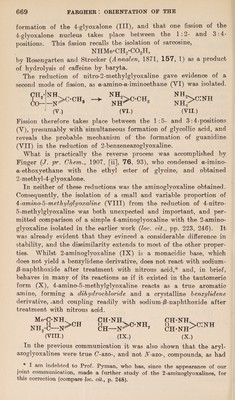
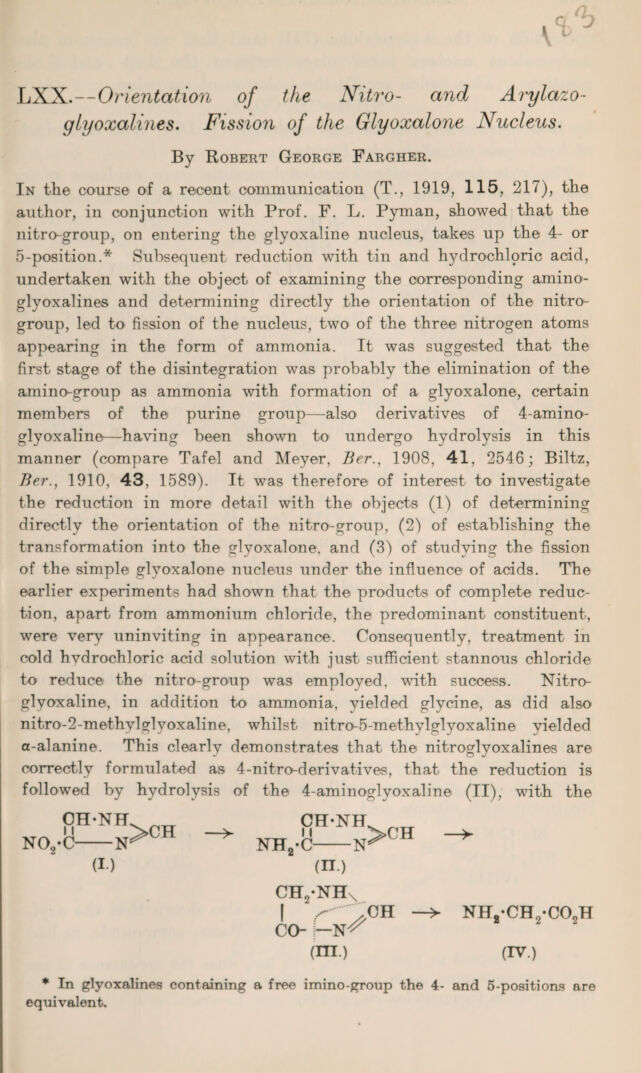
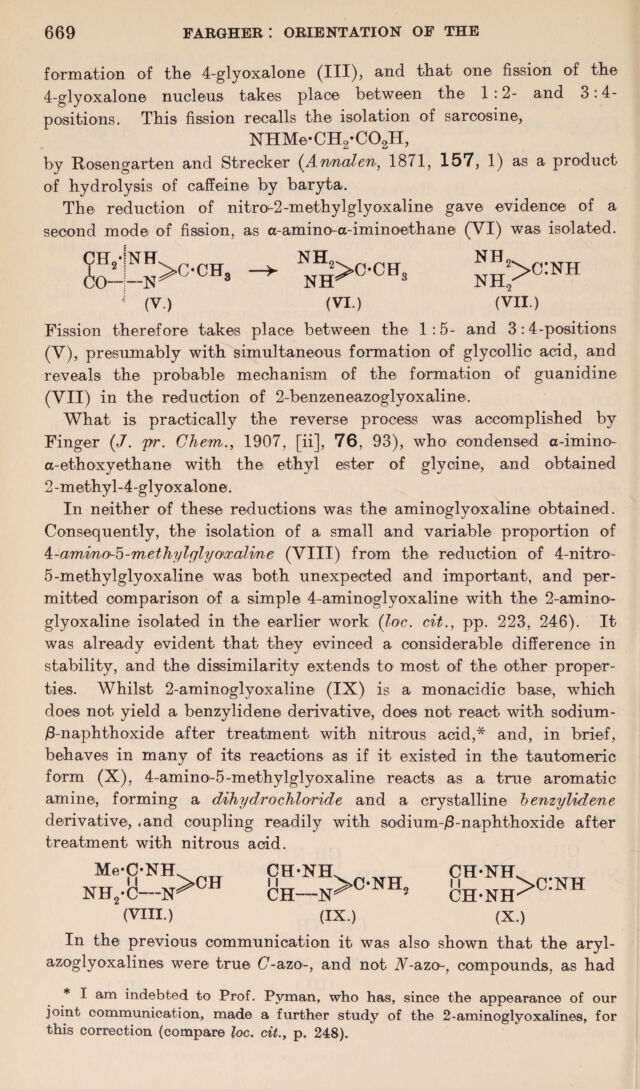
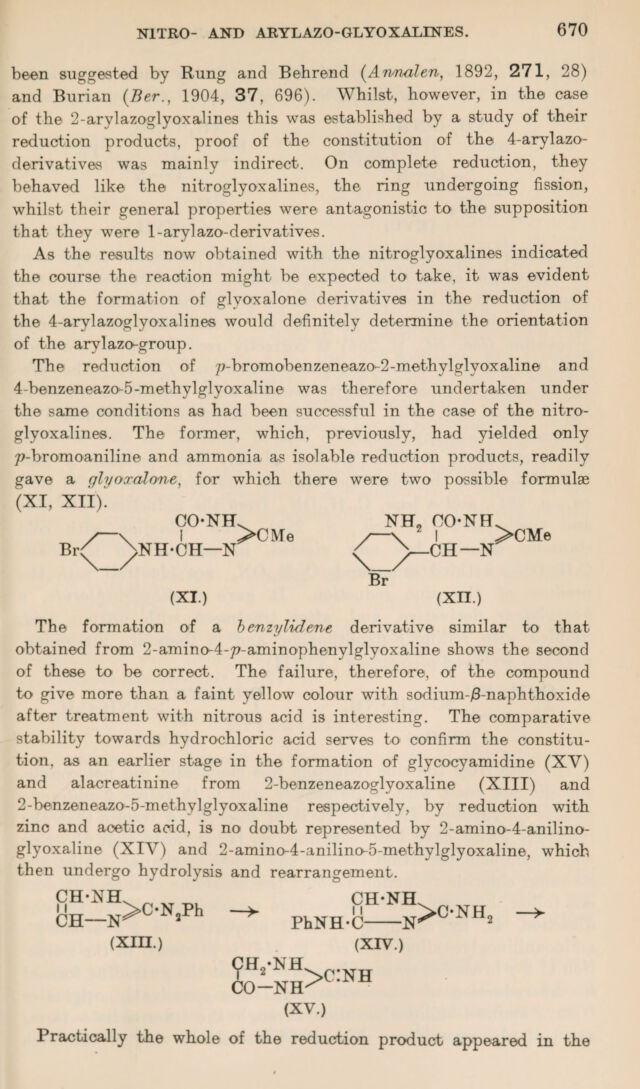
Orientation of the nitro- and arylazo-glyoxalines. Fission of the glyoxaline nucleus / by Robert George Fargher.
- Fargher, Robert George.
- Date:
- 1920.]
Licence: Public Domain Mark
Credit: Orientation of the nitro- and arylazo-glyoxalines. Fission of the glyoxaline nucleus / by Robert George Fargher. Source: Wellcome Collection.
4/14 page 671
![form of an insoluble stannichloride, probably that of 5-amino^ 4-(2/-amino-b1 -b romoph enyl)-2-m ethyl glyoxaline (XYI), as, after Br NHs-ONH NH2-C*NH >—C—N CMe NH, Br NH, -C—N CPh (XVI.) (XVII.) conversion into the hydrochloride, roughly molecular proportions of ammonium chloride and the glyoxalone were obtained on frac¬ tionation. It is therefore permissible to assume that the constitu¬ tion of the reduction product of bromobenzeneazo-2-phenyl- glyoxaline (loc. cit., p. 258) is correctly represented as 5-amino- 4:-(2,-amino-b,-bromophenyl)-sl-phenylglyo'xaline (XVII), the pro¬ duct evincing a greater stability towards acids than the correspond¬ ing 2-methyl derivative. The further study of the reduction of 4-benzeneazo-5-methylglyoxaline was of interest, as two1 products of undetermined constitution had already been isolated, a base C9H]0ON9, from the reduction with tin and hydrochloric acid (loc. cit., p. 254), and a base, C10H11ON3, from the reduction with zinc and acetic acid (loc. cit., p. 255). The reduction with cold stannous chloride has now yielded, in addition to the base, C9H10ON2, a third compound, CinHnON3, not identical with the product of the zinc reduction. It gave a dihydrochloride, a benzylidene derivative, and, after treatment with nitrous acid, coupled with sodium-/3-naphthoxide, and is therefore 2-p-amino- phenyl-b-methyl-^-glyoxalone (XVIII). CHMe-NH CO--N >OC6H4-NH2 (XVIII.) (fHMe-NH CO-N >C-NH-C6H 5 (XIX.) The base from the zinc reduction was monacidic, did not couple, and did not react with benzaldehyde, and is therefore %anilinoJb- mcthylA-glyoxalone (XIX). It is of interest to record that the reactions which have been examined so far indicate that the zinc and acetic acid reduction favours the semidine change, whilst the stannous chloride reduction favours the benzidine change. It does not follow, however, that the reaction proceeds entirely in the one direction, as, for example, a small proportion of 2-5/-bromo-2/- aminoanilinoglyoxaline (loc. cit., p. 246) is produced in the reduc¬ tion of 2-pubromobenzeneazoglyoxaline, whilst the guanidine formed in the reduction of 2-benzeneazoglyoxaline conceivably originates from 2-amino-4-anilinoglyoxaline through the intermediate form¬ ation of glycocyamidine. This is of interest in view of the close](https://iiif.wellcomecollection.org/image/b30622694_0004.jp2/full/800%2C/0/default.jpg)