Licence: Public Domain Mark
Credit: Tin foil and its combinations for filling teeth. Source: Wellcome Collection.
Provider: This material has been provided by the Augustus C. Long Health Sciences Library at Columbia University and Columbia University Libraries/Information Services, through the Medical Heritage Library. The original may be consulted at the the Augustus C. Long Health Sciences Library at Columbia University and Columbia University.
43/120 page 29
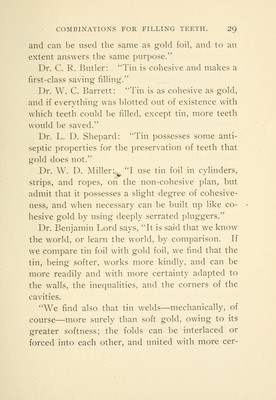
![and can be used the same as gold foil, and to an extent answers the same purpose. Dr. C. R. Butler: Tin is cohesive and makes a first-class saving filling. Dr. W. C. Barrett: ''Tin is as cohesive as gold, and if everything was blotted out of existence with which teeth could be filled, except tin, more teeth would be saved. Dr. L. D. Shepard: 'Tin possesses some anti- septic properties for the preservation of teeth that gold does not. Dr. \\'. D. ]\Iiller: T use tin foil in cvlinders, Strips, and ropes, on the non-cohesive plan, but admit that it possesses a slight degree of cohesive- ness, and when necessary can be built up like co- hesive gold by using deeply serrated pluggers. Dr. Benjamin Lord says, 'Tt is said that we know the world, or learn the world, by comparison. If we compare tin foil with gold foil, we find that the tin, being softer, works more kindly, and can be more readily and with more certainty adapted to the walls, the inequalities, and the corners of the cavities. We find also that tin welds—mechanically, of course—more surely than soft gold, owing to its greater softness; the folds can be interlaced or forced into each other, and united with more cer-](https://iiif.wellcomecollection.org/image/b2123100x_0043.jp2/full/800%2C/0/default.jpg)