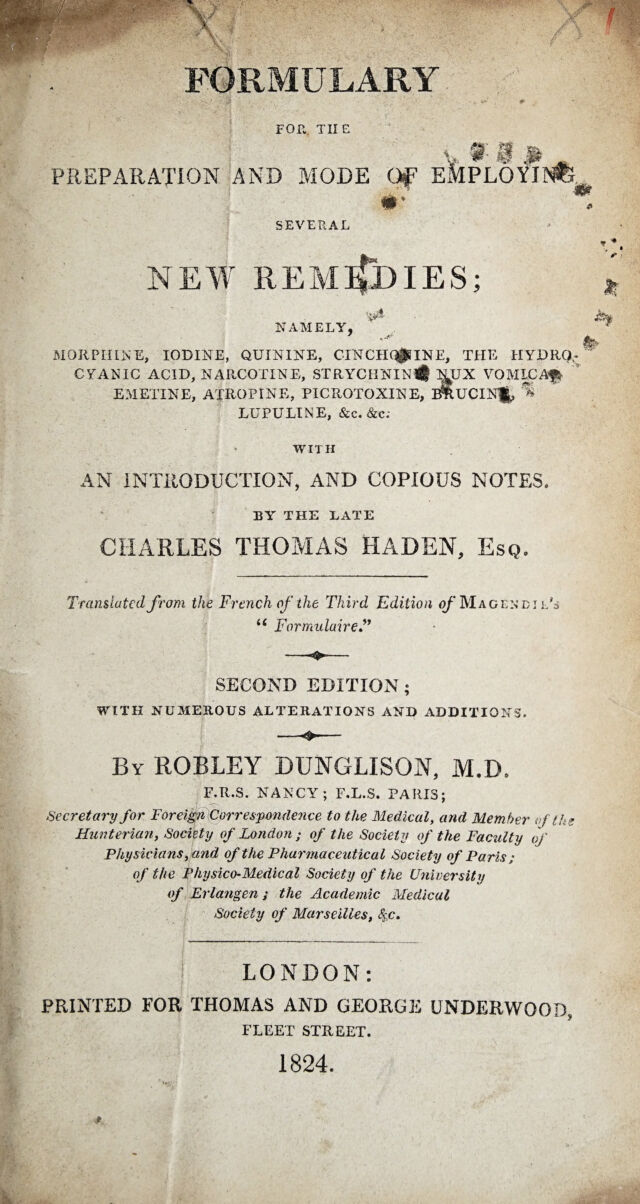
Formulary for the preparation and mode of employing several new remedies : namely, morphine, iodine, quinine ... / with an introduction, and copious notes, by the late Charles Thomas Haden ; translated from the French of the third edition of Magendie's "Formulaire."
- François Magendie
- Date:
- 1824
Licence: Public Domain Mark
Credit: Formulary for the preparation and mode of employing several new remedies : namely, morphine, iodine, quinine ... / with an introduction, and copious notes, by the late Charles Thomas Haden ; translated from the French of the third edition of Magendie's "Formulaire.". Source: Wellcome Collection.
112/174 page 92
![jures. They isolated this acrid principle, in which they recognised all the alkaline charac¬ ters. They ultimately discovered it in the root of the colchicum (colchicmn autumnaleb), and in that of the white hellebore (veratrum commune*) ; and they called it veratrine, from the name of the family to which these vege¬ tables belong. this substance : he found it to consist of — Fixed oil 24.2 ; adipocire 0.43 ; wax 0.1 ; resin, soluble in ether 1.45; resin, insoluble in ether 8.43; veratrine 0.58; bitter extractive, with an undefined acid 5.97 ; sweet ex¬ tractive 0.65 ; gum 4.82 ; oxygenated extractive (ul- trine?) which may be extracted by potass 24.14; woody fibre 20.56 ; phyteumacolle with hydrochlorate of potass, and a vegetable salt with a base of potass i.21 ; oxalate of lime with bassorine 1.06 ; water 6.4.] b [The root of the colchicum, according to MM. Pelletier and Caventou, yields on analysis :—1. A fatty matter com¬ posed of oil, adipocire, and a volatile acid ; 2. Yellow' extractive colouring matter; 3. Acid gallate of veratrine ; 4. Gum ; 5. Fecula, with inuline and woody fibre. It yields very few ashes.] [ihe loot of the veratrum album or commune yields, 1, A fatty matter composed of oil, adipocire, and an acid similar to the cevadic, but incrystallizable ; 2. bellow extiactive colouring matter; 3. Acid gallate of veratrine; 4. Gum; 5. Fecula; 6. Woody fibre. The ashes contain carbonates of potass and lime, sulphate of lime and silica—Pelletier and Caventou.]](https://iiif.wellcomecollection.org/image/b30796568_0112.jp2/full/800%2C/0/default.jpg)