Formulary for the preparation and mode of employing several new remedies : namely, morphine, iodine, quinine ... / with an introduction, and copious notes, by the late Charles Thomas Haden ; translated from the French of the third edition of Magendie's "Formulaire."
- François Magendie
- Date:
- 1824
Licence: Public Domain Mark
Credit: Formulary for the preparation and mode of employing several new remedies : namely, morphine, iodine, quinine ... / with an introduction, and copious notes, by the late Charles Thomas Haden ; translated from the French of the third edition of Magendie's "Formulaire.". Source: Wellcome Collection.
156/174 page 136
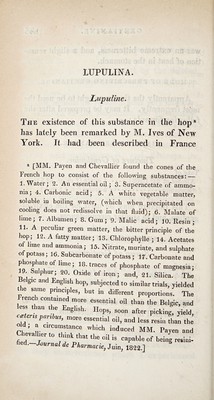
![LUPULINA. Itupuline. The existence of this substance in the hop* has lately been remarked by M. Ives of New York. It had been described in France a [MM. Payen and Chevallier found the cones of the French hop to consist of the following substances: — I. Water; 2. An essential oil ; 3. Superacetate of ammo¬ nia; 4. Carbonic acid; 5. A white vegetable matter, soluble in boiling water, (which when precipitated on cooling does not redissolve in that fluid); 6. Malate of lime; 7. Albumen; 8. Gum ; 9. Malic acid; 10. Resin ; II. A peculiar green matter, the bitter principle of the hop; 12. A fatty matter; 13. Chlorophylle ; 14. Acetates of lime and ammonia; 15. Nitrate, muriate, and sulphate of potass; 16. Subcarbonate of potass ; 17. Carbonate and phosphate of dime; 18. traces of phosphate of magnesia; 19. Sulphur; 20. Oxide of iron; and, 21. Silica. The Belgic and English hop, subjected to similar trials, yielded t le same principles, but in different proportions. The reach contained more essential oil than the Belgic, and less than the English. Hops, soon after picking, yield, catens paribus, more essential oil, and less resin than the old; a circumstance which induced MM. Payen and t;r ;er t0 ! nk that tl,e oil is caPaMe of being resini- -Journal de Pharmacie, Juin, 1822.]](https://iiif.wellcomecollection.org/image/b30796568_0156.jp2/full/800%2C/0/default.jpg)