The attitude and positions, natural and preternatural, of the fœtus in utero, acts of the reflex or excito-motory system / by J. Y. Simpson.
- James Young Simpson
- Date:
- 1849
Licence: Public Domain Mark
Credit: The attitude and positions, natural and preternatural, of the fœtus in utero, acts of the reflex or excito-motory system / by J. Y. Simpson. Source: Wellcome Collection.
Provider: This material has been provided by The University of Glasgow Library. The original may be consulted at The University of Glasgow Library.
18/73 page 12
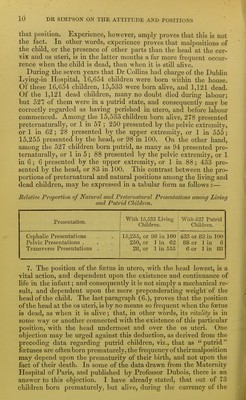
![Section II.—Instinctive and Voluntary Muscular Actions AS the Cause op the Attitude of the Foetus. Some physiologists, as Cabanis, Eanemoser/&c., have upheld that the unborn foetus is ab-eady endowed with physical powers, and ])erforms acts referrible only to the existence and exercise of mind. They maintain that metaphysicians have as yet one department of their science to investigate, viz., the state and degree of develop- ment of psychical life in the inti-a-uterine foetus. Cabanis^ holds that the unborn infant already possesses the consciousness of its own existence with the first traces of fundamental ideas, and has already wants and desires, and both the wiU and the power of exciting volitional muscular movements. Long ago, Ambrose Pare,* and Chamberlen,* attributed the po- sition of the head of the infant at the os uteri in labour to a psychi- cal rather than a physical cause. But the author who has princi- pally maintained and developed the idea, that the position of the child is a psychical result, is Professor Paul Dubois of Paris. In 1832 this distinguished obstetrician communicated to the Academy of Medicine of Paris, an elegant and remarkable essay on the subject. M. Dubois' essay is published in the second vo- lume of the Academy's memoirs, under the title of Memoire sur la cause des Presentations de la Tete pendant I'accouche- ment et sur les determinations instinctives ou volontaires du foetus humain. After showing, by some of the arguments that I have stated in the preceding section, that the position of the foetus, with the head lowest and over the os uteri, is certainly not the result of gra- vitation, M. Dubois, by a kind of reasoning by exclusion, comes to the conclusion, that the position in question must be the result of 1 Historich-physiologische Untersuchungen ueber den Ursprang und das Wesen der menschlichen seele. Bonn 1824. 2 Rapports du Physique et du Moral de rHomme, torn. ii. p. 43]. 3 After speaking of the infant, at the full term of pregnancy, requiring more food than it can now obtain through the vessels of the cord, Pare describes it as endeavouring violently to escape from the uterus to supply its wants, and thus, by its strong violence {grande impetuosity), breaking the membranes. When the womb then begins to open, the childe (says he), pursuing the aire which heefeeleth to enter in at the mouth of tlve womb, is carried with its head downwards.—Para's Works, English translation, p. 899. Of the celebrated obstetric family of the Cliamberlens—the inventors of the forceps—we have few or no literary remains. Hugh Cliamberlen, one of the sons, translated the work of Mauriceau, and has added a few sparse notes of his own. To the passage which I have already quoted in a preceding page from Mauriceau, regarding his belief iu the preponderating weiglit of tlie head of the foetus being the cause of its common position, Chamberlen affixes as an annotation, that the foetal head comes lowest, and to the os rather by a natu- Tiil propensity than any weight of the head.—Translation of Mauriceau on Diseases of Women with Child, Sec, p. 147.](https://iiif.wellcomecollection.org/image/b21470807_0018.jp2/full/800%2C/0/default.jpg)




 No text description is available for this image
 No text description is available for this image
 No text description is available for this image