Volume 1
The geography of Strabo / Literally translated, with notes. The first six books by H. C .Hamilton, esq., the remainder by W. Falconer.
- Strabo
- Date:
- 1854-1857
Licence: Public Domain Mark
Credit: The geography of Strabo / Literally translated, with notes. The first six books by H. C .Hamilton, esq., the remainder by W. Falconer. Source: Wellcome Collection.
394/542 page 380
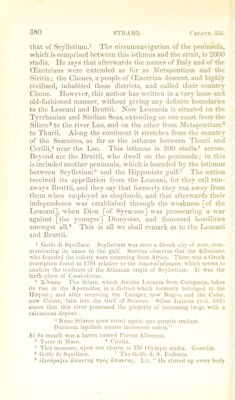
![that of Scylletium.i The circumnavigation of the peninsula, which is comprised between this isthmus and the strait, is 2000 stadia. He says that afterwards tlie names of Italy and of the GEnotrians were extended as far as Metapontium and the Siritis ; the Chones, a people of Qiinotrian descent, and highly civilized, inhabited these districts, and called their country Chone. However, this author has written in a very loose and old-fashioned manner, without giving any definite boundaries to the Leucani and Bruttii. Now Leucania is situated on the Tyrrhenian and Sicilian Seas, extending on one coast from the Silaro^ to the river Lao, and on the other from Metapontium^ to Thurii. Along the continent it stretches from the country of the Samnites, as far as the isthmus between Thurii and Cerilli,* near the Lao. This isthmus is 300 stadia^ across. Beyond are the Bruttii, who dwell on the peninsula ; in this is included another peninsula, which is bounded by the isthmus between Scylletium® and the Hipponiate gulf.' The nation received its appellation from the Leucani, for they call run- aways Bruttii, and they say that formerly they ran away from them when employed as shepherds, and that afterwards their independence was established through the weakness [of the Leucani], when Dion [of Syracuse] was prosecuting a war against [the younger] Dioin^sius, and fomented hostilities amongst all.® This is all we shall remark as to the Leucani and Bruttii. ’ Golfo di Sqiiillace. Scylletium was once a Greek city of note, com- municating its name to the gulf. Servius observes that the .\thenians who founded the colony were returning from .Vfrica. There was a Greek inscription found in 1791 relative to the Aaft^a^tjcpofiia, which seems to coiilinn the tradition of the .\thenian origin of Scylletium. It was llie biith-place of Cassiodorus. SiXapic. The Silaro, which divides Lucania from Campania, takes its rise in the Apennines, in a district which formerly belonged to the Hirpini; and after receiving the Tanager, now Negro, and the Calor, now Galore, falls into the Gulf of Salerno. Silius Italicus (viii. 6S2) states that this river possessed the property of inciusting twigs with a calcareous deposit: “ Nunc Silarus qtios nutrit aquis, quo gurgite tradunt Duritiem lapidum mersis inolcscere ramis.” At its mouth was a haven named Portus .\lbernus. “ Torre di Mare. * Cirella. ^ This measure, upon our charts, is .130 Olympic stadia. Gossclin. ® Golfo di Squillacc. The Golfo di S. Eufemia. ' i^iTapa^d’ uTrai’Tai rrpof uTmerag. Lit. “ He stirred up every body](https://iiif.wellcomecollection.org/image/b24872556_0001_0394.jp2/full/800%2C/0/default.jpg)