A treatise on the diseases of the eye.
- Wells, J. Soelberg (John Soelberg), -1879.
- Date:
- 1869
Licence: Public Domain Mark
Credit: A treatise on the diseases of the eye. Source: Wellcome Collection.
Provider: This material has been provided by the Gerstein Science Information Centre at the University of Toronto, through the Medical Heritage Library. The original may be consulted at the Gerstein Science Information Centre, University of Toronto.
20/788 page 2
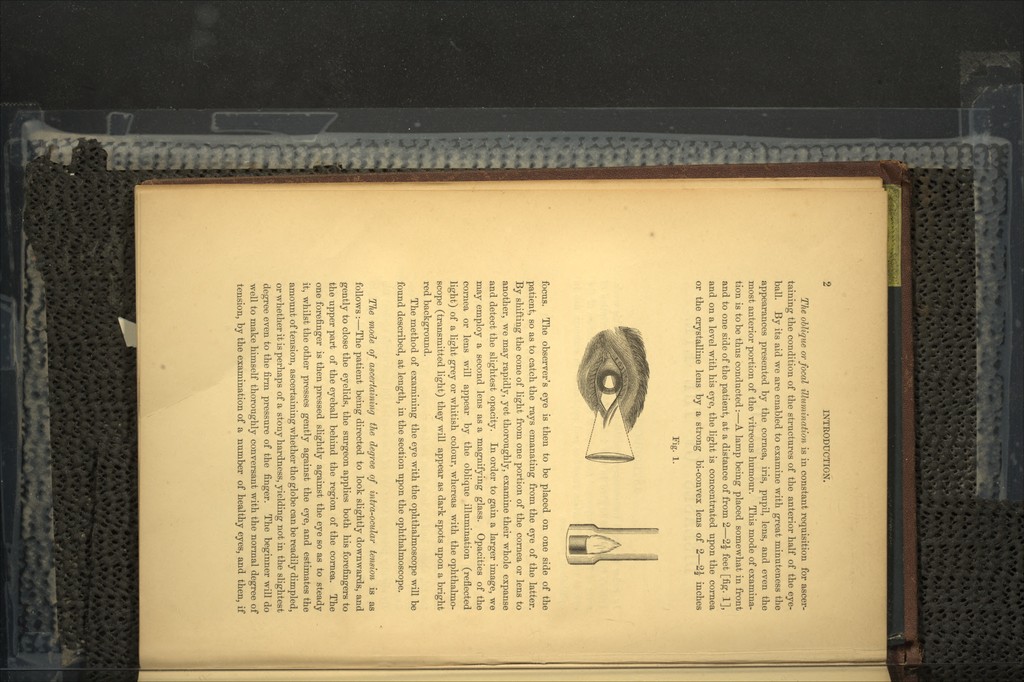
![The oblique or focal illumination is in constant requisition for ascer- taining the condition of the structures of the anterior half of the eye- ball. By its aid we are enabled to examine with great minuteness the appearances presented by the cornea, iris, pupil, lens, and even the most anterior portion of the vitreous humour. This mode of examina- tion is to be thus conducted:—A lamp being placed somewhat in front and to one side of the patient, at a distance of from 2—2£ feet [fig. 1], and on a level with his eye, the light is concentrated upon the cornea or the crystalline lens by a strong bi-con vex lens of 2—2j inches Fig. 1. focus. The observer's eye is then to be placed on one side of the patient, so as to catch the rays emanating from the eye of the latter. By shifting the cone of light from one portion of the cornea or lens to another, we may rapidly, yet thoroughly, examine their whole expanse and detect the slightest opacity. In order to gain a larger image, we may employ a second lens as a magnifying glass. Opacities of the cornea or lens will appear by the oblique illumination (reflected light) of a light grey or whitish colour, whereas with the ophthalmo- scope (transmitted light) they will appear as dark spots upon a bright red background. The method of examining the eye with the ophthalmoscope will be found described, at length, in the section upon the ophthalmoscope. The mode of ascertaining the degree of intra-ocular tension is as follows :—The patient being directed to look slightly downwards, and gently to close the eyelids, the surgeon applies both his forefingers to the upper part of the eyeball behind the region of the cornea. The one forefinger is then pressed slightly against the eye so as to steady it, whilst the other presses gently against the eye, and estimates the amount of tension, ascertaining whether the globe can be readily dimpled, or whether it is perhaps of a stony hardness, yielding not in the slightest degree even to the firm pressure of the finger. The beginner will do well to make himself thoroughly conversant with the normal degree of tension, by the examination of a number of healthy eyes, and then, if](https://iiif.wellcomecollection.org/image/b20996391_0020.jp2/full/800%2C/0/default.jpg)