A text-book of histology : arranged upon an embryological basis / by Frederic T. Lewis and Philipp Stöhr.
- Frederic Thomas Lewis
- Date:
- [1913]
Licence: In copyright
Credit: A text-book of histology : arranged upon an embryological basis / by Frederic T. Lewis and Philipp Stöhr. Source: Wellcome Collection.
95/560
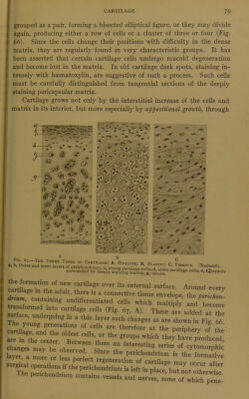
![grouped as a pair, forming a bisected elliptical figure, or they may divide again, producing either a row of cells or a cluster of three or four (Fig. 66). Since the cells change their positions with difficulty in the dense matrix, they are regularly found in very characteristic groups. It has been asserted that certain cartilage cells undergo mucoid degeneration and become lost in the matrix. In old cartilage dark spots, staining in- tensely with hasmatoxylin, are suggestive of such a process. Such cells must be carefully distinguished from tangential sections of the deeply staining pericapsular matrix. Cartilage grows not only by the interstitial increase of the cells and matrix in its interior, but more especially by appositional growth, through a, b, Outer and innerfeyerlofpertehoa^um^TVou B’Elastic: C, Fibrous. (Radasch). surrounded by deeply stafnfng matrixfj1facunl? Cartilage cells= e> «cap.ule the formation of new cartilage over its externa] surface. Around every cartilage in the adult, there is a connective tissue envelope, the ferichol £“7 COni g ™di“ated cells which multiply and?b ome tansformed into cartilage cells (Fig. 67, A). These are added at the ace, undergoing m a thin layer such changes as are shown in Fig 66](https://iiif.wellcomecollection.org/image/b28115065_0095.jp2/full/800%2C/0/default.jpg)