Human physiology, statical and dynamical, or, The conditions and course of the life of man / by John William Draper.
- John William Draper
- Date:
- 1856
Licence: Public Domain Mark
Credit: Human physiology, statical and dynamical, or, The conditions and course of the life of man / by John William Draper. Source: Wellcome Collection.
Provider: This material has been provided by the Augustus C. Long Health Sciences Library at Columbia University and Columbia University Libraries/Information Services, through the Medical Heritage Library. The original may be consulted at the the Augustus C. Long Health Sciences Library at Columbia University and Columbia University.
108/684 page 86
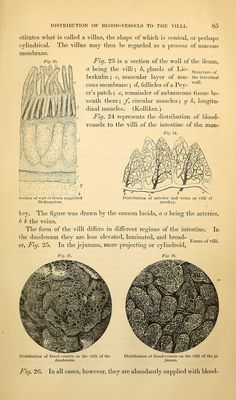
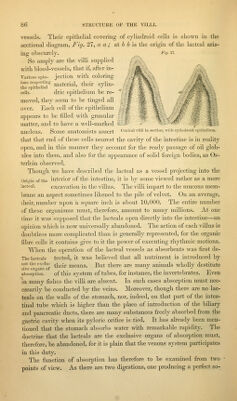
![■\-essels. Their epithelial covering of cylindroid cells is shown in the sectional diagram, Fig. 27, a a ; at h h is, the origin of the lacteal aris- ing obscurely. Fkj 2t So amply are the ^olli supplied with blood-vessels, that if, after in- Various opin- jection with coloring ions respecting j^^terial, their cylin- the epithelial _ _ _ -^ cells. dric epithehum be re- moved, they seem to be tinged all over. Each cell of the epithelium p -^ ^^ appears to be filled with g-ranular ^ ,, ^ / ^'' xz matter, and to have a well-marked J-^ '^ ' ' ._ nucleus. Some anatomists assert Conical viUi in section, with cj-Undrold epitheUum. that that end of these cells nearest the cavity of the intestine is in reality open, and in this manner they account for the ready passage of oil glob- Liles into them, and also for the appearance of solid foreign bodies, as Os- terlein observed. Though we have described the lacteal as a vessel projecting into the Origin of the interior of the intestine, it is by some viewed rather as a mere lacteal. excavation in the villus. The villi impart to the mucous mem- brane an aspect sometimes likened to the pile of velvet. On an average, their, number upon a square inch is about 10,000. The entire number of these organisms must, therefore, amount to many millions. At one time it was supposed that the lacteals open dii-ectly into the intestine—an opinion which is now universally abandoned. The action of each villus- is doubtless more complicated than is generally represented, for the organic fibre cells it contains give to it the power of executing rhythmic motions. When the operation of the lacteal vessels as absorbents was first de- The lacteals tected, it was believed that all nutriment is introduced by not the exciu- ^|^gj„ jj^gans. But there are manv animals whoUv destitute sive organs of i • i t-' absorption. of this svstem of tubes, for instance, the mvertebrates. Lven in many fishes the villi are absent. Li such cases absorption must nec- essarily be condu.cted by the veins. ]\Ioreover, though there are no lac- teals on the walls of the stomach, nor, indeed, on that part of the intes- tinal tube which is higher than the place of introduction of the biHary and pancreatic ducts, there are many substances freely absorbed from the o-astric cavity when its pyloric orifice is tied. It has already been men- tioned that the stomach absorbs water with remarkable rapidity. The doctrine that the lacteals are the exclusive organs of absoi-ption must, therefore, be abandoned, for it is plaui that the venous system participates in this duty. The function of absoiiDtion has therefore to be examined from two points of view. As there are two digestions, one producing a perfect so-](https://iiif.wellcomecollection.org/image/b21223993_0108.jp2/full/800%2C/0/default.jpg)
 No text description is available for this image
 No text description is available for this image
 No text description is available for this image