The German universities for the last fifty years / by Dr. J. Conrad, authorized translation by John Hutchinson and a preface by James Bryce.
- Johannes Conrad
- Date:
- 1885
Licence: Public Domain Mark
Credit: The German universities for the last fifty years / by Dr. J. Conrad, authorized translation by John Hutchinson and a preface by James Bryce. Source: Wellcome Collection.
342/380 page 302
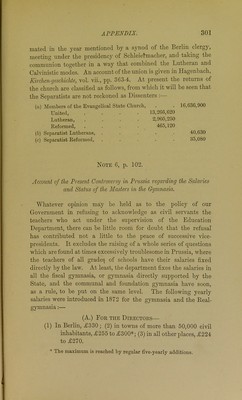
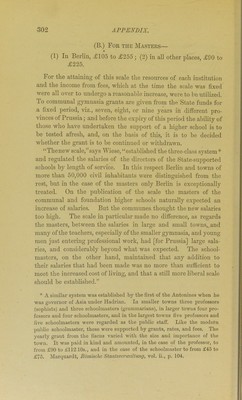
![(B.) For the Masters— (1) lu Berlin, £105 to £255 ; (2) in all other places, £90 to £225. For the attaining of this scale the resources of each institution and the income from fees, which at the time the scale was fixed were all over to undergo a reasonable increase, were to he utilized. To communal gymnasia grants are given from the State funds for a fixed period, viz., seven, eight, or nine years in different pro- vinces of Prussia; and before the expiry of this period the ability of those who have undertaken the support of a higher school is to be tested afresh, and, on the basis of this, it is to be decided whether the grant is to be continued or withdrawn. “Thenew scale,”says Wiese, “established the three-class S3'stem * and regulated the salaries of the directors of the State-supported schools by length of service. In this respect Berlin and towns of more tlian 50,000 civil inhabitants wei’e distinguished from the rest, but in the case of the masters only Berlin is exceptionally treated. On the publication of the scale the masters of the communal and foundation higher schools naturally expected an increase of salaries. But the communes, thought the new salaries too high. The scale in particular made no difference, as regards the masters, between the salaries in large and small towns,, and many of the teachers, especially of the smaller gymnasia, and young men just entering professional work, had [for Prussia] large sala- ries, and considerably beyond what was expected. The school- masters, on the other hand, maintained that any addition to their salaries that had been made was no more than sufficient to meet the increased cost of living, and that a still more liberal scale should be established.” * A similar system was established by the first of the Antonines when he was governor of Asia under Hadrian. In smaller towns three professors (sophists) and three schoolmasters (grammarians), in larger towns four pro- fessors and four schoolmasters, and in the largest towns five professors and live schoolmasters were regarded as the public staff. Like the modern public schoolmaster, these were supported by grants, rates, and fees. The yearly grant from the fiscus varied with the size and importance of the town. It was paid in kind and amounted, in the case of the professor, to from £90 to £112 10s., and in the case of the schoolmaster to from £45 to £75. Marquardt, Pomische SlaaUverwaltung, vol. ii., p. 104. I](https://iiif.wellcomecollection.org/image/b24860955_0342.jp2/full/800%2C/0/default.jpg)
 No text description is available for this image
 No text description is available for this image
 No text description is available for this image