The pharmacopoeia of the Royal College of Physicians of London [1824] / A translation ... by Richard Phillips.
- Date:
- 1824
Licence: Public Domain Mark
Credit: The pharmacopoeia of the Royal College of Physicians of London [1824] / A translation ... by Richard Phillips. Source: Wellcome Collection.
Provider: This material has been provided by the Royal College of Physicians of Edinburgh. The original may be consulted at the Royal College of Physicians of Edinburgh.
120/420 (page 98)
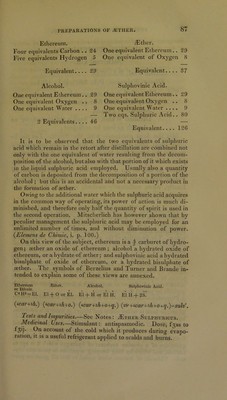
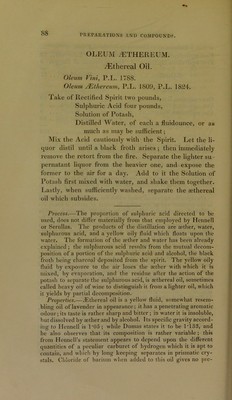
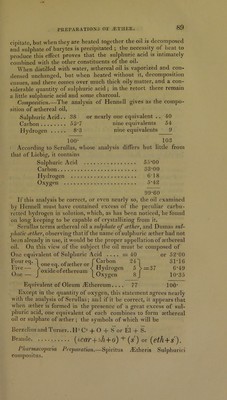
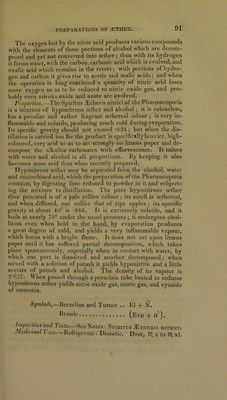
![During sublimation, however, one of the equivalents of the ammonia liberated and one of the water formed are dissipated; whilst the quantity of carbonic acid remaining undiminished, the carbonate actually sublimed consists of three equivalents of car- bonic acid and only two of ammonia, which, as just shown, consti- tute it a sesquicarbonate. Symbols,—Berzelius and Turner HJ N + 1+ (J + H. Brande..... n + 3h or A + 1+CCIV + (]. Properties.—When recently prepared, sesquicarbonate of am- monia is a colourless translucent mass of a striated crystalline appearance, and it is moderately hard. Its smell is pungent, and its taste sharp and penetrating ; turmeric paper when held over it is turned of a reddish brown colour by the carbonate of ammonia which escapes. It is soluble in about four times its weight of cold water, and by hot water it is decomposed with effervescence. When the bottle which contains this salt is fre- quently opened, or if a small quantity of it be kept in a large bottle, it gradually becomes opake and friable, and its pungency is much diminished ; if it be exposed to the air for some time, it is rendered quite devoid of smell, owTing to the volatilization of neutral carbonate of ammonia, bicarbonate being left; and it will be observed that a compound of three equivalents of carbonic acid and two of ammonia, is equal to one equivalent of neutral car- bonate, which evaporates, and one of bicarbonate of ammonia,which remains as an inodorous salt combined with water, consisting of Two eqs. Carbonic Acid ..22x2=44 or Carbonic Acid 55’7 0 One equivalent of Ammonia =17 „ Ammonia.... 21 ‘52 Two equivalents of Water. . 9x2 = 18 „ Water 22'78 Equivalent.... =79 100* Incompaliblcs.—Sesquicarbonate of ammonia is decomposed by acids, by potash and soda, and their carbonates; by lime, lime- water, solution of chloride of calcium, magnesia, alum, acidulous salts, as bitartrate and bisulphate of potash, and solutions of iron, except the potassio-tartrate ; bichloride of mercury, the acetate and diacetate of lead, sulphate of iron and of zinc, are also in- compatible with this salt. With sulphate of magnesia it affords no precipitate. Officinal Preparations.—Liquor Ammonite Sesquicarbonatis, Liquor Ammoniae Acetatis, Cupri Ammonio-sulphas, &c. Medicinal Uses.—It is stimulant, antispasmodic, diaphoretic, powerfully antacid, and in large doses emetic. In the form of smelling salts it is useful in syncope and hysteria. It must not be kept in powdered mixtures, and although in the form of pill](https://iiif.wellcomecollection.org/image/b21960707_0120.jp2/full/800%2C/0/default.jpg)