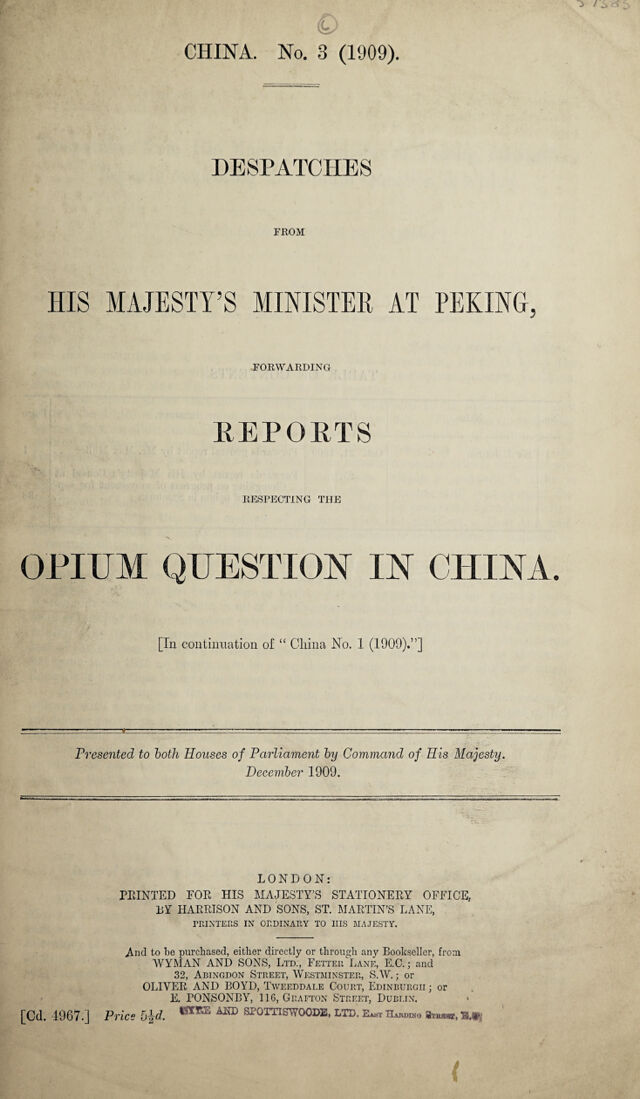
Despatches from Sir A. Hosie forwarding reports respecting the opium question in China.
- Alexander Hosie
- Date:
- [1911]
Licence: Public Domain Mark
Credit: Despatches from Sir A. Hosie forwarding reports respecting the opium question in China. Source: Wellcome Collection.
17/52 page 15
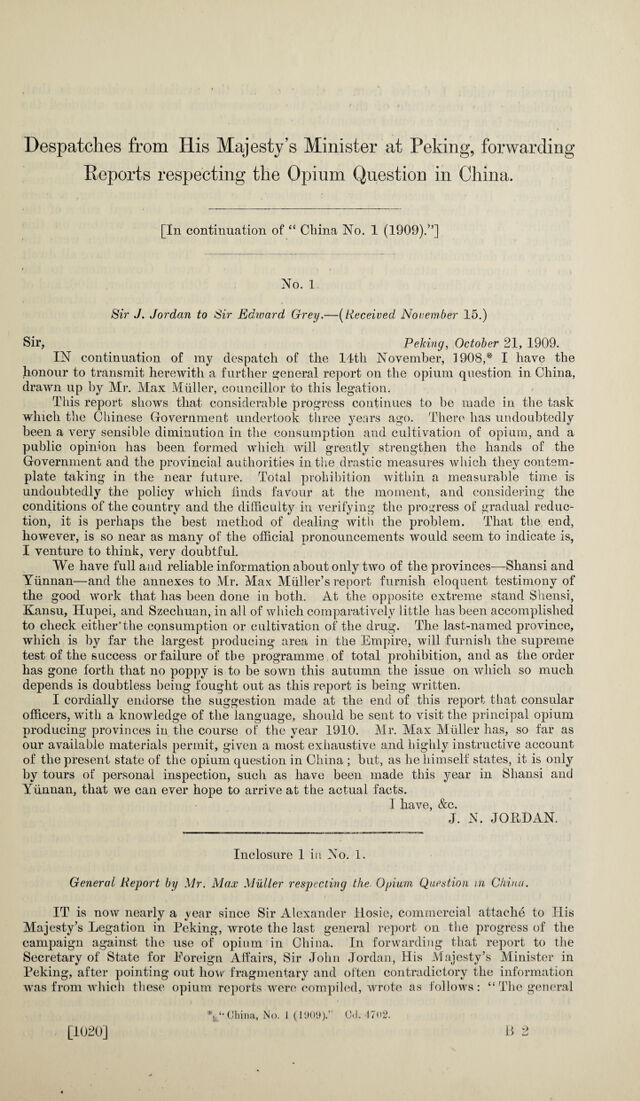
![“ The cultivation of the poppy in the district of Ilolichiang has diminished by one-half. It is now only grown in one or two places.” All these missionaries also agreed in saying that there was a considerable decrease in the number of smokers, though smoking still went on chiefly in secret, all opium dens being shut. In the Amoy consular district the authorities have shown themselves equally, if not more, in earnest. In the Tung-an district, formerly the principal source of native opium, the magistrate began a personal inspection of the villages when the time came for the poppy to show above ground and, when any was found, destroyed the crop and arrested the village elders. In one case where the villagers showed fight he had the villages burnt. The result is that the reduction of acreage under poppy in the Tung-an district has surpassed the most sanguine hopes : along roads where formerly nothing but poppies grow not a plant was to be seen this spring. In the other districts the story is much the same, the cultivation has been everywhere enormously reduced; only in two small districts the missionaries reported that the orders against planting had not been obeyed, while a British merchant who was travelling in the province in April reported that about 30 miles from Foochow up the Min Iliver he had found about 30 acres of land under poppy. Hupei. “ Little or no progress ” was Sir A. Hosie’s verdict as to this province, and after nearly a year’s interval it is difficult to modify that verdict to any appreciable extent, The reports on the progress of the movement in Hupei are most contradictory, but it seems clear that even if the numerous regulations issued have had some effect in Hankow and other large cities, little or nothing has been done in the remoter districts. Considerable progress seems to have been made in suppressing the use of the drug among the high officials, military officers, and students in the cities of Wuchang, Hanyang and Hankow. A head office for the suppression of opium in Hupei has heen established in Wuchang, and regulations were issued there imposing heavy penalties for the illicit sale or consumption of opium and for the sale of smoking utensils. The gentry and mercantile classes of Wuchang are said to be specially keen on the work of suppression, but the richer merchants of Hankow and Hanyang do not take the official action seriously and have laid in large stores of opium. All dens in Hankow have been closed, the officials themselves making several raids and severely punishing delinquents, but in the suburbs dens are still secretly open. His Majesty’s consul at Ichang reports that the dens at Icliang, Sliasi, and other riverside towns have been officially closed, and that in March a deputy arrived to enforce the regulations for the registration and licensing of opium shops and opium smokers. The reports of the missionaries make it clear that outside the large cities the regulations of the opium suppression bureau remain for the most part a dead letter. From the Lachokou district, the only large opium-growing country of Hupei, a discouraging report says that the local officials have done nothing to diminish the growth of the poppy nor the number of smokers, and that in one district more poppy had been planted than in the previous year. Opium dens were as numerous as ever and did a thriving trade. From other parts come similar tales of orders issued, and either openly or secretly disregarded; but where the magistrates are determined the story is very different. At Hsiaokan Hsien, for instance, a missionary reported that the dens were closed, and the small crop of poppy formerly raised had disappeared; that no officials dared to smoke, as those caught were promptly dismissed, and that the magistrates had a load or two of opium pipes and lamps smashed in public every few days. At Tsao Shill again an energetic magistrate is reported to have personally inspected and shut down all opium dens, confiscated smoking implements, and arrested and beaten the den-keepers. Of the numerous regulations issued by the opium bureau, the most important have been those imposing a tax on licences to smokers renewable every month, and prohibiting the sowing of poppy after the autumn crop of the present year. As a matter of fact very little opium has ever been grown in Hupei, though the province has always been a veritable hotbed of the vice. According to the reports of the Customs commissioners, at least 20 per cent, of the total population smoke, amongst many young women. To satisfy the demand large quantities of opium are imported, especially from Szechuan and Yunnan, though it is impossible to give any accurate estimate of the total importation into the province. [1020] C](https://iiif.wellcomecollection.org/image/b3136553x_0017.jp2/full/800%2C/0/default.jpg)


 No text description is available for this image
 No text description is available for this image
 No text description is available for this image