A system of instruction in qualitative chemical analysis / by Dr. C. Remigius Fresenius .. ; edited by J. Lloyd Bullock, F.C.S.
- Carl Remigius Fresenius
- Date:
- 1855
Licence: Public Domain Mark
Credit: A system of instruction in qualitative chemical analysis / by Dr. C. Remigius Fresenius .. ; edited by J. Lloyd Bullock, F.C.S. Source: Wellcome Collection.
31/342 page 5
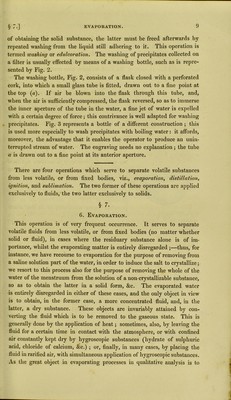
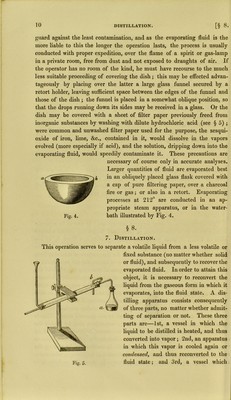
![► § 3.] Crystallization aud precipitation are the reverse of solution, since they have for their object the conversion of a fluid or dissolved substance to the solid state. As both depend on the same cause, viz., on the absence of a solvent, it is impossible to assign exact limits to either; in many cases they merge into one another. We must, however, consider them separately here, since they differ essentially in their extreme forms; and, moreover, since the special objects which we purpose to attain by their application are, in most cases, very different. § 3. 2. Crystallization. We understand by the term crystallization, in a more general sense, every operation, or process, whereby bodies are induced to pass from the fluid to the solid state, and to assume certain regular, determinate, geome- trical forms. But, as these forms, which we call crystals, arc the more regular, and consequently the more perfect, the more slowly the operation is carried on, we always connect with the term “ crystallization” the accessory idea of a slow separation—of a gradual conversion to the solid state. The formation of crystals depends on the regular arrangement of the ultimate constituent particles of bodies (molecules or atoms); it can only take place, therefore, if these atoms possess perfect freedom of motion, and thus in general only when a substance passes from the fluid or gaseous to the solid state. Those cases in which the mere ignition, or the softening or moistening of a solid body suffices to make the tendency of the mole- cules to a regular arrangement (crystallization) prevail over the diminished force of cohesion—(such as, for instance, the turning white and opaque of moistened barley-sugar) — are to be regarded as exceptions to the rule. To induce crystallization, the causes of the fluid or gaseous form of a substance must be removed. These causes are either heat alone, e. g. in the case of fused metals ; or solvents alone, as in the case of an aqueous solution of common salt; or both combined, as in the case of a hot and saturated aqueous solution of nitrate of potassa. In the first case we obtain crystals by cooling the fused mass ; in the second, by evaporating the menstruum; and in the third by either of these means. The most frequently occurring case is that of crystallization by cooling hot saturated solutions. The liquors which remain after the separation of the crystals are called mother-waters, or mother-liquors. The term amorphous is applied to such solid bodies as have no crystalline form. We have recourse to crystallization generally either to obtain the crys- tallized substance in a solid form, or to separate it from other substances dissolved in the same menstruum. The form of the crystals also affords in some cases an excellent means of distinguishing between otherwise analo- gous bodies ; for instance, between nitrate of soda and nitrate of potassa.](https://iiif.wellcomecollection.org/image/b28080361_0031.jp2/full/800%2C/0/default.jpg)