A system of instruction in qualitative chemical analysis / by Dr. C. Remigius Fresenius .. ; edited by J. Lloyd Bullock, F.C.S.
- Carl Remigius Fresenius
- Date:
- 1855
Licence: Public Domain Mark
Credit: A system of instruction in qualitative chemical analysis / by Dr. C. Remigius Fresenius .. ; edited by J. Lloyd Bullock, F.C.S. Source: Wellcome Collection.
33/342 page 7
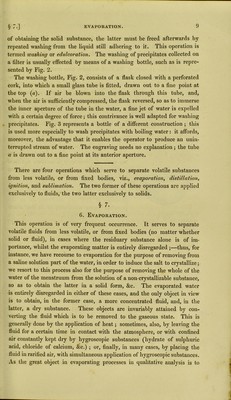
![FILTRATION. §5-] / fluid which contains a precipitate so finely divided and so inconsiderable in amount, that the suspended particles, although impairing the transparency of the fluid, yet cannot be clearly distinguished. The separation of floc- culent precipitates may generally be promoted by a vigorous shake of the vessel; that of crystalline precipitates, by stirring the fluid and rubbing the sides of the vessel with a glass rod; elevation of temperature is also an effective means of promoting the separation of most precipitates. The process is therefore conducted, according to circumstances, either in test- tubes, flasks, or beakers. The two operations described respectively in §§ 5 and 6, vizfiltration and decantation, serve to effect the mechanical separation of fluids from matter suspended therein. § 5. 4. Filtration. This operation consists simply in passing the fluid from which we wish to remove the mechanically suspended solid particles, through a filtering apparatus, formed usually by a properly arranged piece of unsized paper placed in a funnel; an apparatus of this description allows the fluid to trickle through with ease, whilst it completely retains the solid particles. We employ smooth filters and plaited filters : the former, in cases where the separated solid substance is to be made use of; the latter in cases where it is simply intended to clear the solution. Smooth filters are prepared by double folding a circular piece of paper, so that the folds form right angles. The preparation of plaited filters is more properly a matter for ocular demonstration than for description. In cases where the contents of the filter require washing, the latter must not project over the edge of the funnel. It is in most cases advisable to moisten the filter previously to passing the fluid through it; since this not only tends to accelerate the process, but also renders the solid particles less liable to pass through the pores of the filter. The paper selected for filters must be as free as possible from inorganic substances, especially from such as are dis- solved by acids, sesquioxide of iron, lime, &c. Swedish filtering paper answers the purpose best; the common filtering paper of commerce requires careful washing with dilute hydrochloric acid to fit it for use in accurate analyses. To this end the paper is cut into quarter sheets and a layer of ten or twelve of them placed in a shallow porcelain dish, and digested for several hours at a moderate heat with a mixture of one part of hydro- chloric acid and nine parts of water. The dilute acid is then poured off, and the paper repeatedly washed with water (finally distilled water), until litmus paper is no longer reddened by the washings; the water is then drained off, and the sheets are carefully placed, in a heap, upon some](https://iiif.wellcomecollection.org/image/b28080361_0033.jp2/full/800%2C/0/default.jpg)