A synopsis of natural history : embracing the natural history of animals, with human and general animal physiology, botany, vegetable physiology, and geology / translated from the latest French edition of C. Lemmonnier, with additions from the works of Cuvier, Dumaril, Lacepede, etc., and arranged as a text book for schools by Thomas Wyatt.
- Lemonnier, Céran
- Date:
- 1839
Licence: Public Domain Mark
Credit: A synopsis of natural history : embracing the natural history of animals, with human and general animal physiology, botany, vegetable physiology, and geology / translated from the latest French edition of C. Lemmonnier, with additions from the works of Cuvier, Dumaril, Lacepede, etc., and arranged as a text book for schools by Thomas Wyatt. Source: Wellcome Collection.
Provider: This material has been provided by the National Library of Medicine (U.S.), through the Medical Heritage Library. The original may be consulted at the National Library of Medicine (U.S.)
46/198
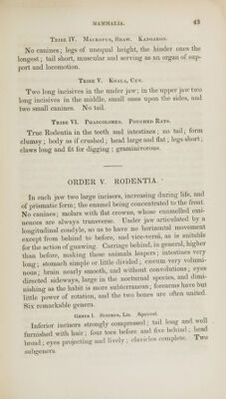
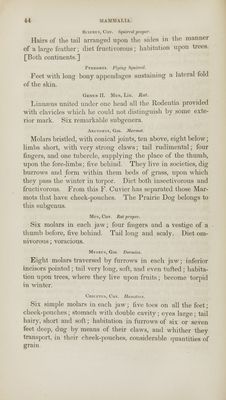
![ORDER IV. MARSUPIALIA* Premature production of their young, which, incapable of movement and possessing hardly the germs of limbs, attach themselves to the mammae of the mother, there to perfect their development. The skin of the abdomen generally disposed in the form of a pouch about the mammse, and sup- ported by two articulated bones in the pelvis, called marsu- pial bones. One striking feature in this order is, that, although there is great similarity in one species to another, yet they vary very much in the teeth, digestive organs and feet. They appear to be the connecting link from the Carnaria to the Rodentia; and some animals having the marsupial bones, but entirely without teeth, have been placed with the Eden- tata. Six tribes. Tribe I. Didelphis, Lin. Opossum. Long canines and small incisors in both jaws. One re- markable genus, the Opossums, have fifty teeth; the posterior thumbs long and easily opposable, a circumstance which has caused them to be termed Pedimana; tail prehensile and in part naked; fetid, nocturnal animals, with a slow gait; ha- bitation upon trees. [America alone.] Tribe II. Phalangista, Cuv. Phalangers. Upper canines long and pointed; the inferior almost invi- sible ; thumb large; the two toes united as far as the first phalanx. There are two remarkable genera. The Pkalanger proper has a prehensile tail, often in a great measure scaly ; diet insectivorous and fructivorous; habitation upon trees. [The Moluccas.] The Flying Phalanger has an extension of the skin of the sides, forming a parachute; habitation upon trees. [New Holland.] Tribe III. Hypsiprymnus, Illig. Potoroos. No posterior thumb nor inferior canines; toes united as in the Phalano-ers. Pouched.](https://iiif.wellcomecollection.org/image/b21136427_0046.jp2/full/800%2C/0/default.jpg)
 No text description is available for this image
 No text description is available for this image
 No text description is available for this image