A synopsis of natural history : embracing the natural history of animals, with human and general animal physiology, botany, vegetable physiology, and geology / translated from the latest French edition of C. Lemmonnier, with additions from the works of Cuvier, Dumaril, Lacepede, etc., and arranged as a text book for schools by Thomas Wyatt.
- Lemonnier, Céran
- Date:
- 1839
Licence: Public Domain Mark
Credit: A synopsis of natural history : embracing the natural history of animals, with human and general animal physiology, botany, vegetable physiology, and geology / translated from the latest French edition of C. Lemmonnier, with additions from the works of Cuvier, Dumaril, Lacepede, etc., and arranged as a text book for schools by Thomas Wyatt. Source: Wellcome Collection.
Provider: This material has been provided by the National Library of Medicine (U.S.), through the Medical Heritage Library. The original may be consulted at the National Library of Medicine (U.S.)
54/198
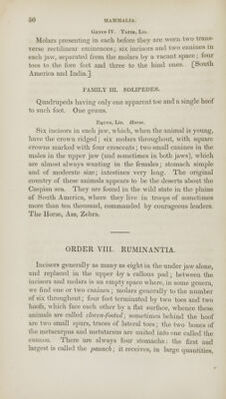
![Genus IV. Tapir, Lin. Molars presenting in each before they are worn two trans- verse rectilinear eminences; six incisors and two canines in each jaw, separated from the molars by a vacant space; four toes to the fore feet and three to the hind ones. [South America and India.] FAMILY III. SOLIPEDES. Quadrupeds having only one apparent toe and a single hoof to such foot. One genus. Equus, Lin. Horse. Six incisors in each jaw, which, when the animal is young, have the crown ridged; six molars throughout, with square crowns marked with four crescents; two small canines in the males in the upper jaw (and sometimes in both jaws), which are almost always wanting in the females; stomach simple and of moderate size; intestines very long. The original country of these animals appears to be the deserts about the Caspian sea. They are found in the wild state in the plains of South America, where they live in troops of sometimes more than ten thousand, commanded by courageous leaders. The Horse, Ass, Zebra. ORDER VIII. RUMINANTIA. Incisors generally as many as eight in the under jaw alone, and replaced in the upper by a callous pad; between the incisors and molars is an empty space where, in some genera, we find one or two canines; molars generally to the number of six throughout; four feet terminated by two toes and two hoofs, which face each other by a flat surface, whence these animals are called cloven-footed; sometimes behind the hoof are two small spurs, traces of lateral toes; the two bones of the metacarpus and metatarsus are united into one called the cannon. There are always four stomachs: the first and largest is called the paunch; it receives, in large quantities,](https://iiif.wellcomecollection.org/image/b21136427_0054.jp2/full/800%2C/0/default.jpg)