A manual of magnetism : including galvanism, magnetism, electro-magnetism, electro-dynamics, magneto-electricity, and thermo-electricity.
- Davis, Daniel
- Date:
- 1847
Licence: Public Domain Mark
Credit: A manual of magnetism : including galvanism, magnetism, electro-magnetism, electro-dynamics, magneto-electricity, and thermo-electricity. Source: Wellcome Collection.
Provider: This material has been provided by the National Library of Medicine (U.S.), through the Medical Heritage Library. The original may be consulted at the National Library of Medicine (U.S.)
40/346
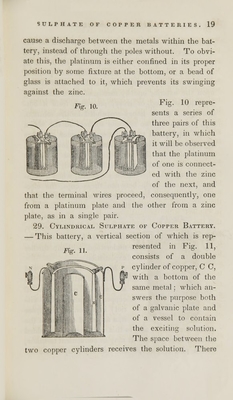
![is a movable cylinder of zinc, marked Z in the sectional view, which is let down into this solution whenever the battery is to be put in action. It is, of course, intermediate in size, as well as in position, to the two copper cylinders, and is made to rest upon the exterior one by means of three insulating branches of Avood or ivory, projecting from it out- wardly. Thus it hangs suspended in the solution, and presents its two opposite surfaces to the action of the liquid, and to the inner and outer cylinders of copper respectively. There is a screw-cup, N, connected with the zinc cylinder, and also one marked P, with the copper cylinder; and, according to the principles heretofore explained, when a com- munication is made between these cups, the elec- tricity developed by the action within the battery will pass from one to the other. Fig. 12 is a perspective view of the same battery, in which the parts will be understood without further explanation. 30. The liquid employed to put this battery in action is a solution of sulphate of copper (common blue vit- riol) in water. To prepare it, a saturated solution of the salt is first made, and to this solution is then added as much more water. It may be convenient to know that a pint of water, at the ordinary temperature of Fig. ]2.](https://iiif.wellcomecollection.org/image/b21113774_0040.jp2/full/800%2C/0/default.jpg)