[Report 1948] / Medical Officer of Health, Dartford R.D.C.
- Dartford (England). Rural District Council.
- Date:
- 1948
Licence: Attribution 4.0 International (CC BY 4.0)
Credit: [Report 1948] / Medical Officer of Health, Dartford R.D.C. Source: Wellcome Collection.
13/26 page 11
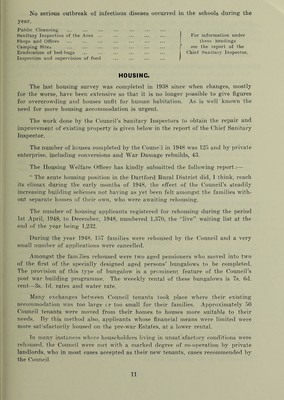
![No serious outbreak of infectious diseaes occurred in the schools during the year. Public Cleansing Sanitary Inspection of the Area .. Shops and Offices Camping Sites Eradication of bed-bugs Inspection and supervision of food For information under these headings see the report of the Chief Sanitary Inspector. HOUSING. The last housing survey was completed in 1938 since when changes, mostly for the worse, have been extensive so that it is no longer possible to give figures for overcrowding and houses unfit for human habitation. As is well known the need for more housing accommodation is urgent. The work done by the Council’s Sanitary Inspectors to obtain the repair and improvement of existing property is given l)elow in the report of the Chief Sanitary Inspector. The number of houses completed by the Council in 1948 was 125 and by private enterprise, including conversions and War Damage rebuilds, 43. The Housing Welfare Officer has kindly submitted the following report:—- “ The acute housing ijosition in the Hartford Rural District did, I think, reach its climax during the early months of 1948, the effect of the Council’s steadily increasing building schemes not having as yet been felt amongst the families with- out separate homes of their own, who were awaiting rehousing. The number of housing applicants registered for rehousing during the period 1st April, 1948, to December, 1948, numbered 1,370, the “live” waiting list at the end of the year being 1,232. During the year 1948, 157 families were rehoused by the Council and a very small number of applications were cancelled. Amongst the families rehoused were two aged pensioners who moved into two of the first of the specially designed aged persons’ bungalows to be completed. The provision of this type of bungalow is a prominent feature of the Council’s post war building ]n‘ogramme. The weeekly rental of these bungalows is 7s. fid. rent—3s. Id. rates and water rate. Many exchanges between Council tenants took place where their existing accommodation was too large cr too small for their families. Approximately 50 Council tenants were moved from their homes to houses more suitable to their needs. By this method also, applicants whose financial means were limited were more satisfaetoT-ily housed on the pre-war Estates, at a lower rental. In many instances where householders living in unsatisfactory conditions were rehoused, the Council were met with a marked degree of co-operation by private landlords, who in most eases accepted as their new tenants, cases recommended by the Council.](https://iiif.wellcomecollection.org/image/b29150437_0015.jp2/full/800%2C/0/default.jpg)
 No text description is available for this image
 No text description is available for this image
 No text description is available for this image