[Report 1948] / Medical Officer of Health, Dartford R.D.C.
- Dartford (England). Rural District Council.
- Date:
- 1948
Licence: Attribution 4.0 International (CC BY 4.0)
Credit: [Report 1948] / Medical Officer of Health, Dartford R.D.C. Source: Wellcome Collection.
4/26 page 2
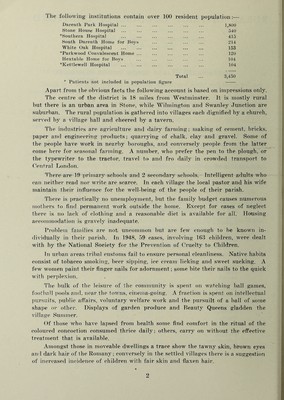
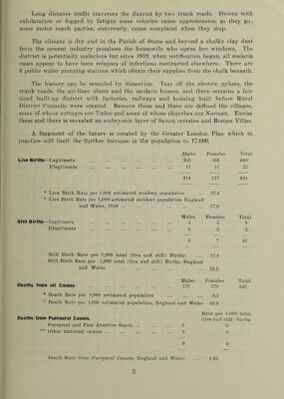
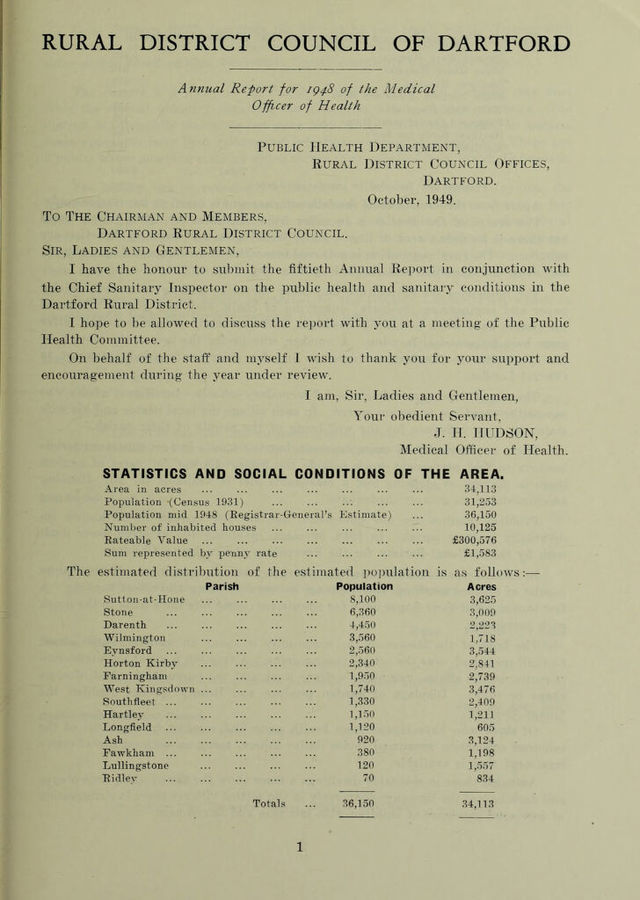
![The following inslitntions contain over 100 resident population:— Darenth Park Hospital ... ... 1,800 Stone House Hospital ... 540 ^Southern Hospital ... ... ... ... ... ... 415 South Darenth Home for Boys ... ... ... ... 214 White Oak Hospital ... ... ... ... ... ... 153 *Parkwood Convalescent Home ... ... ... ... ... 120 Hextabie Home for Boys ... ... ... ... ... 104 *Kettlewell Hospital ... ... ... ... ... ... 104 Total ... 3,450 * Patients not included in population figure Apart from the obvious facts the following account is based on impressions only. The eenti-e of the district is 18 miles from Westminster. It is mostly rural but there is an urban area in Stone, while AVilmington and Swanley Junction are suburban. The rural population is gathered into villages efich dignified by a church, served by a village hall and cheered by a tavern. The industries are agriculture and dairy farming; making of cement, bricks, paper and engineering iiroduets; quarrying of chalk, clay and gravel. Some of the people have work in nearby boi'oughs, and conversely people from the latter come hei-e for seasonal farming. A number, who prefer the pen to the plough, or the typewriter to the tractor, travel to and fro daily in crowded transport to rVntj'al London. There are 19 primary schools and 2 secondary schools. Intelligent adults who can neither read noi- write are scarce. In each village the local pastor and his wife maintain their influence for the well-being of the people of their parish. There is ])ractically no unemployment, but the family budget causes numerous mothers to find permanent work outside the home. Except for cases of neglect there is no lack of clothing and a reasonable diet is available for all. lionising accommodation is gi'avely inadequate. Pi'oblem families ai-e not, uncommon but are few enough to be known in- dividually in their parish. In 1948, 59 cases, involving 163 children, were dealt with by the National Society for the Prevention of Cruelty to Children. In urban ai'eas tribal customs fail to ensure personal cleanliness. Native habits consist of tobacco smoking, beer sii)i)ing, ice cream licking and sweet sucking. A few women paint their finger nails for adornment; some bite their nails to the quick with perplexion. The bulk of the leisure of the community is s])ent on watching ball games, football pools and, near the towns, cinema-going. A fraction is si)ent on intellectual l)ursuits, imblic affairs, voluntary welfare work and the pursnilt of a ball of some shape or othei-. Displays of garden produce and Beauty Queens gladden the village Summer. Of those who have la])sed from health some find comfort in the ritual of the coloured coiieoction consumed thrice daily; others, carry on without the effective treatment that is available. Amongst those in moveable dwellings a trace show the tawny skin, brown eyes and dark hair of the Romany; conversely in the settled villages there is a suggestion of increased incidence of childreji with fair skin and flaxen hair.](https://iiif.wellcomecollection.org/image/b29150437_0006.jp2/full/800%2C/0/default.jpg)