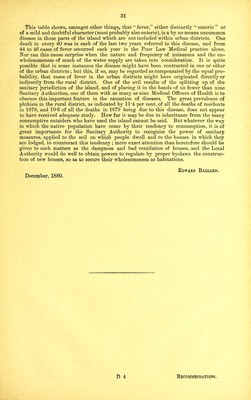
Dr. Ballard's report on the sanitary condition and administration of the Isle of Wight.
- Ballard, Edward
- Date:
- 1881
Licence: Public Domain Mark
Credit: Dr. Ballard's report on the sanitary condition and administration of the Isle of Wight. Source: Wellcome Collection.
Provider: This material has been provided by London School of Hygiene & Tropical Medicine Library & Archives Service. The original may be consulted at London School of Hygiene & Tropical Medicine Library & Archives Service.
33/38 page 33
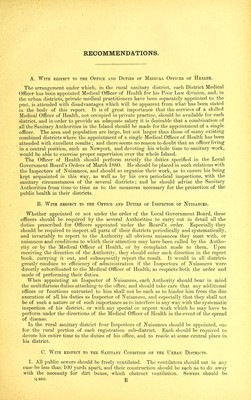
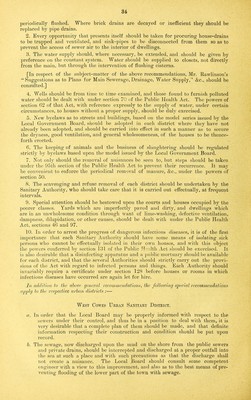
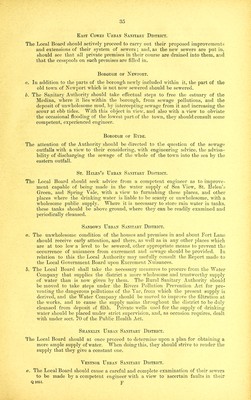
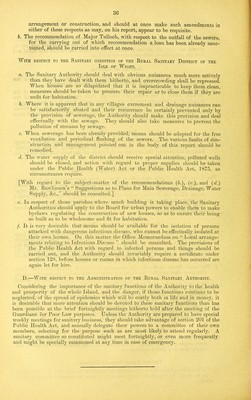
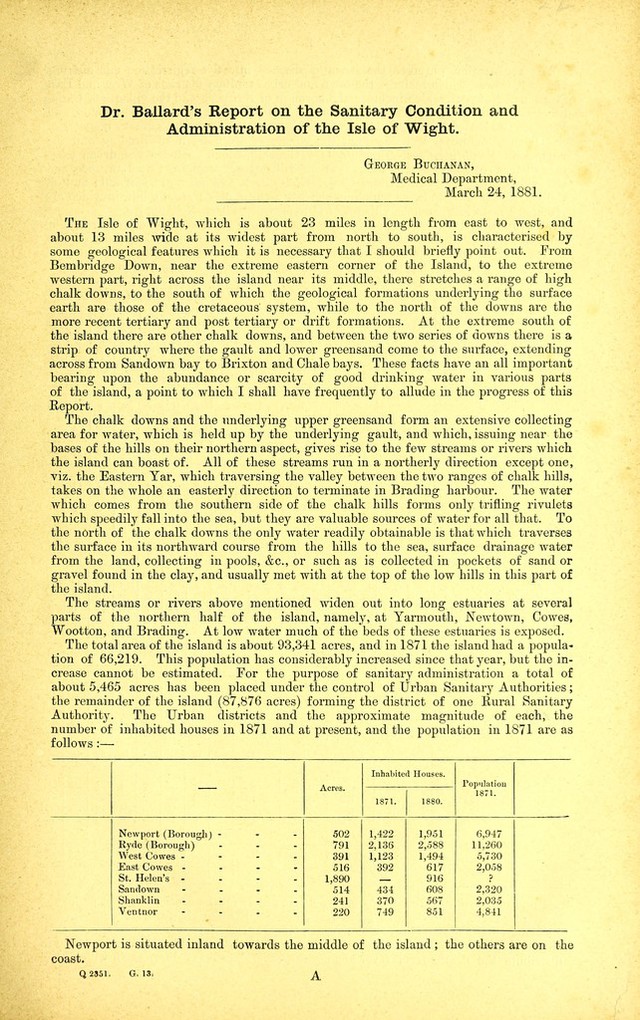
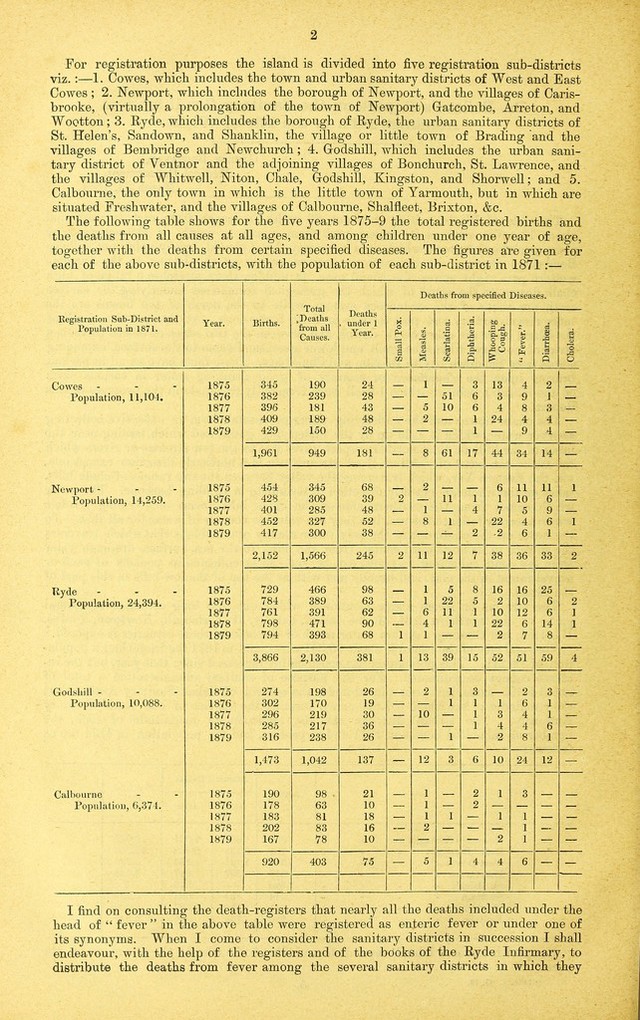
![A. With respect to the Office and Duties of Medical Officer of Health. The arrangement under which, in the rural sanitary district, each District Medical Officer has been appointed Medical Officer of Health for his Poor Law division, and, in the urban districts, private medical practitioners have been separately appointed to the post, is attended with disadvantages which will be apparent from what has been stated in the body of this report. It is of great importance that the services of a skilled Medical Officer of Health, not occupied in private practice, should be available for each district, and in order to provide an adequate salary it is desirable that a combination of all the Sanitary Authorities in the Island should be made for the appointment of a single officer. The area and population are large, but not larger than those of many existing combined districts where the appointment of a single Medical Officer of Health has been attended with excellent results ; and there seems no reason to doubt that an officer living in a central position, such as Newport, and devoting his whole time to sanitary work, would be able to exercise proper supervision over the whole Island. The Officer of Health should perform strictly the duties specified in the Local Government Board’s Orders of March 1880. He should be placed in such relations with the Inspectors of Nuisances, and should so organise their work, as to ensure his being kept acquainted in this way, as well as by his own periodical inspections, with the sanitary circumstances of the several districts; and he should advise the Sanitary Authorities from time to time as to the measures necessary for the protection of the public health in their districts. B. With respect to the Office and Duties of Inspector of Nuisances. Whether appointed or not under the order of the Local Government Board, these officers should be required by the several Authorities to carry out in detail all the duties prescribed for Officers appointed under the Board’s order. Especially they should be required to inspect all parts of their districts periodically and systematically, and invariably to report to the Authority all obvious nuisances they meet with, or nuisances and conditions to which their attention may have been called by the Autho- rity or by the Medical Officer of Health, or by complaint made to them. Upon receiving the direction of the Authority, they should enter such direction in the report book, carrying it out, and subsequently report the result. It would in all districts greatly conduce to efficiency of administration if the Inspectors of Nuisances were directly subordinated to the Medical Officer of Health, as respects both the order and mode of performing their duties. When appointing an Inspector of Nuisances, each Authority should bear in mind the multifarious duties attaching to the office, and should take care that any additional offices or functions entrusted to him shall not be such as to hinder him from the due execution of all his duties as Inspector of Nuisances, and especially that they shall not be of such a nature or of such importance as to interfere in any way with the systematic inspection of his district, or with any special or urgent work which he may have to perform under the directions of the Medical Officer of Health in the event of the spread of disease. In the rural sanitary district four Inspectors of Nuisances should be appointed, one for the rural portion of each registration sub-district. Each should be required to devote his entire time to the duties of his office, and to reside at some central place in his district. C. With respect to the Sanitary Condition of the Urban Districts. 1. All public sewers should be freely ventilated. The ventilators should not in any case be less than 100 yards apart, and their construction should be such as to do away with the necessity for dirt boxes, which obstruct ventilation. Sewers should be Q 2351. J]](https://iiif.wellcomecollection.org/image/b24996889_0035.jp2/full/800%2C/0/default.jpg)