Lectures on man: being a series of discourses on phrenology and physiology / Delivered by Professor L.N. Fowler in Great Britain.
- Lorenzo N. Fowler
- Date:
- 1886
Licence: Public Domain Mark
Credit: Lectures on man: being a series of discourses on phrenology and physiology / Delivered by Professor L.N. Fowler in Great Britain. Source: Wellcome Collection.
Provider: This material has been provided by the Francis A. Countway Library of Medicine, through the Medical Heritage Library. The original may be consulted at the Francis A. Countway Library of Medicine, Harvard Medical School.
31/368 page 25
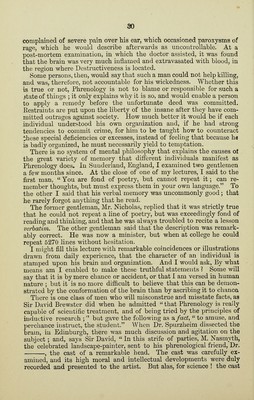
![tbe activity as well as the size of the organs. Some may say that there is a spirit or power independent of the brain, wliich manifests mind; if this were so, why do not all men then exhibit the same mental or moral qualities alike 1 Artists and sculptors, without reference to Phrenology, paint or represent a talented man with a prominent frontal lobe ; but if they were to paint an idiot, they would be considered poor artists if they left upon the canvas the broad forehead of Lord Bacon, The fourth physiological proof is, that as physical exercise does not exhaust the whole body, neither does mental labour exhaust the whole brain. A person may have digested a hearty dinner, when the digestive organs would need rest ; but he could afterwards walk, perhaps, two or three miles with impunity. Then, wearied with physical exercise in one direction, he can ride on horseback for several hours. This would not be the case unless there was a great variety and number of muscles wliich can be employed. The same is true with regard to the mind. We know that a person may exercise one class of faculties till the brain becomes weary, when, by using other faculties as vigorously, the first set are rested. A man may spend five hours in close study ; with a wearied brain, he can go into society and exercise his social faculties, execute music, or listen to the performances of others on the piano, when he will forget his weariness. This would not be the case if the brain was an unit, but because there is a plurality of faculties, the person is able to change from one occupation to another, with benefit rather than injury. The first pathological proof is, that injuries of the brain frequently impair some of the mental faculties, while the others remain in a healthy condition. A person may receive a wound and lose his memory of names, and yet retain a remembrance of passing events. There is a multitude of facts with regard to injuries of the brain. A boy, ten years of age, had a blow which depressed his skull, but for a time he did not manifest any unfavourable symptoms ; gradually, he lost his memory and judgment, till he died at the age of forty an idiot in intellect. Dr. Gal] cites the case of an aeronaut who fell and struck his head. After the accident he was subject to attacks of apoplexy, and died at fifty-three in an apoplectic fit. When Mabillon was eighteen years of age, he could neither talk, read, nor write. He had a fall, when he was trepanned. During his recovery, he saw a copy of Euclid, and made great progress in studying it. Haller cites a case of a boy who was idiotic from birth. He had a wound on his brain ; was apparently cured by the accident, but as soon as the wound was healed, he returned to his former mental condition. Sometimes there is too great a pressure upon the brain by the skull, and in such a case, even when the person has lost a portion of the brain by an accident, the activity of parts or of the whole has been increased by the accident. Some anti-phrenologists, who may be found among metaphysicianjs and medical men, have asserted that they have known 12*](https://iiif.wellcomecollection.org/image/b21053029_0031.jp2/full/800%2C/0/default.jpg)

 No text description is available for this image
 No text description is available for this image
 No text description is available for this image