Lectures on man: being a series of discourses on phrenology and physiology / Delivered by Professor L.N. Fowler in Great Britain.
- Lorenzo N. Fowler
- Date:
- 1886
Licence: Public Domain Mark
Credit: Lectures on man: being a series of discourses on phrenology and physiology / Delivered by Professor L.N. Fowler in Great Britain. Source: Wellcome Collection.
Provider: This material has been provided by the Francis A. Countway Library of Medicine, through the Medical Heritage Library. The original may be consulted at the Francis A. Countway Library of Medicine, Harvard Medical School.
65/368 page 59
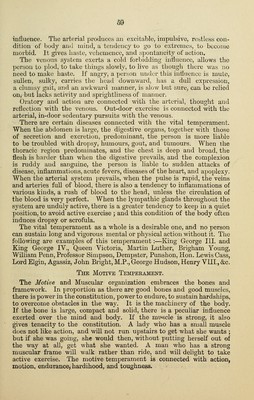
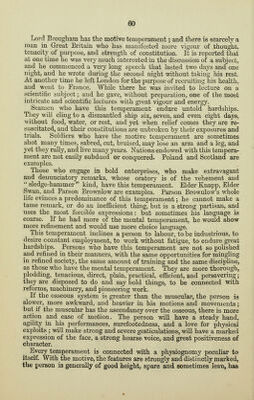
![6§ influence. The arterial ]3roduces an excitable, impulsive, restless con- dition of body and mind, a tendency to go to extremes, to become morbid. It gives haste, vehemence, and sj^ontaneity of action. The venous system exerts a cold forbidding influence, allows the person to plod, to take things slowly, to live as though there was no need to make haste. If angry, a per.-ion under this iuHuence is mute, sullen, sulky, carries the head downward, has a dull expression, a clumsy gait, and an awkward manner, is slow but sure, can be relied on,-but lacks activity and sprightliness of manner. Oratory and action are connected with the arterial, thought and reflection with the venous. Out-door exercise is connected with the arterial, in-door sedentary pursuits with the venous. There are certain diseases connected with the vital temperament. When the abdomen is large, the digestive organs, together with those of secretion and excretion, predominant, the person is more liable to be troubled with dropsy, humours, gout, and tumours. When the thoracic region predominates, and the chest is deep and broad, the flesh is harder than when the digestive prevails, and the complexion is ruddy and sanguine, the person is liable to sudden attacks of disease, inflammations, acute fevers, diseases of the heart, and apoplexy. When the arterial system prevails, when the pulse is rapid, the veins and arteries full of blood, there is also a tendency to inflammations of various kinds, a rush of blood to the head, unless the circulation of the blood is very perfect. When the lympathic glands throughout the system are unduly active, there is a greater tendency to keep in a quiet position, to avoid active exercise ; and this condition of the body often induces dropsy or scrofula. The vital temperament as a whole is a desirable one, and no person can sustain long and vigorous mental or physical action without it. The following are examples of this temperament:—King George III. and King George lY., Queen Victoria, Martin Luther, Brigham Young, WiUiam Penn, Professor Simpson, Dempster, Punshon, Hon. Lewis Cass, Lord Elgin, Agassiz, John Bright, M.P,, George Hudson, Henry YHI., &c. The Motive Temperament. The Motive and Muscular organization embraces the bones and framework. In proportion as there are good bones and good muscles, there is power in the constitution, power to endure, to sustain hardships, to overcome obstacles in the way. It is the machinery of the body. If the bone is large, compact and solid, there is a peculiar influence exerted over the mind and body. If the muscle is strong, it also gives tenacity to the constitution. A lady who has a small muscle does not like action, and will not run upstairs to get what she wants ; but if she was going, she would then, without putting herself out of the way at all, get what she wanted. A man who has a strong muscular frame will walk rather than ride, and will delight to take active exercise. The motive temperament is connected with action, motion, endurance, hardihood, and toughness.](https://iiif.wellcomecollection.org/image/b21053029_0065.jp2/full/800%2C/0/default.jpg)
 No text description is available for this image
 No text description is available for this image
 No text description is available for this image