Lectures on man: being a series of discourses on phrenology and physiology / Delivered by Professor L.N. Fowler in Great Britain.
- Lorenzo N. Fowler
- Date:
- 1886
Licence: Public Domain Mark
Credit: Lectures on man: being a series of discourses on phrenology and physiology / Delivered by Professor L.N. Fowler in Great Britain. Source: Wellcome Collection.
Provider: This material has been provided by the Francis A. Countway Library of Medicine, through the Medical Heritage Library. The original may be consulted at the Francis A. Countway Library of Medicine, Harvard Medical School.
70/368 page 64
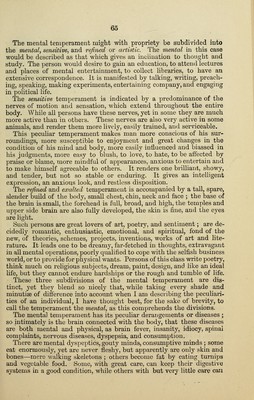
![smitli, or as an arcTiitect; but he cannot engage iu any hard mecha- nical work with continued success and health. We call this temperament mental, because whenever there is a pre- dominance of the nervous system there is a predominance of mind ; and, as before stated, when the nervous system is healthy, there is power to readily put into execution what the desires and inclinations dictate ; but if there is a want of locomotive power or of nerve power, the individual will be slow. Some children have a strong body, but not much activity, and other children generally wait upon them. There is a difference in organization, and temperaments make this difference in a great degree. In proportion as there is brain there is mind. It does not follow that if a person has the mental temperament he will necessarily develope great mental powers, for circumstances may not have been favourable for the person to have gained an education; but, with a good and thorough education, and a healthy mental temperament, much can be accom]-)lished in a literary channel. The vital tempera- ment gives life, vitality, animal impulse, and generating power, to be exhausted in prolonging and sustaining life ; the motive gives power of endurance, capacity to accomplish, to be thorough, and to carry a thing to completion ; but the mental temperament is the climax of the phy- sical state and condition. It gives sensation, susceptibility, and capacity for improvement. The oyster cannot be improved or educated, because it has not the nervous temperament or a brain. In proportion as an animal has the nervous temperament it can be improved, as the race- horse. The brain makes the body its servant, and hence the whole body is the medium of mental manifestation. If the brain is larger in propor- tion than the body, it is liable to exhaust the body, because the exhausting power is the brain. If the brain is small in proportion to the size of the body, the person is liable to take on an excess of vitality, to generate life without exhausting it through the mental susceptibi- lities : such a person will not die prematurely from nervous exhaustion. I prefer to call this temperament mental rather than nervous. Some are nervous because they have taken strong tea, stimulated too much, been bereaved of friends, and because the nervous system is in pre- dominance ; but the mental being dependent upon nerve, is indicated when there is a predominance of nerve over bone and vitality. Some have their nerves nearer the surface, and they feel every outward sen- sation more keenly ; while others are internal in their character, and but few really know and understand their real dispositions. It is not well for any person to have this temperament in excess, because balance of power in the organization is much more desirable. We need a framework, good bones and muscles, as well as good nerves and a healthy brain. Mind may be powerful in a twofold sense. There may be power with and over the body, and power as confined to philosophical truths and subjects.](https://iiif.wellcomecollection.org/image/b21053029_0070.jp2/full/800%2C/0/default.jpg)
 No text description is available for this image
 No text description is available for this image
 No text description is available for this image