Our teeth : how to take care of them / by Victor C. Bell ; with an introduction by Ossian H. Lang.
- Bell, Victor C. (Victor Charles), 1867-
- Date:
- [1901], ©1901
Licence: Public Domain Mark
Credit: Our teeth : how to take care of them / by Victor C. Bell ; with an introduction by Ossian H. Lang. Source: Wellcome Collection.
Provider: This material has been provided by the Augustus C. Long Health Sciences Library at Columbia University and Columbia University Libraries/Information Services, through the Medical Heritage Library. The original may be consulted at the the Augustus C. Long Health Sciences Library at Columbia University and Columbia University.
78/88 (page 72)
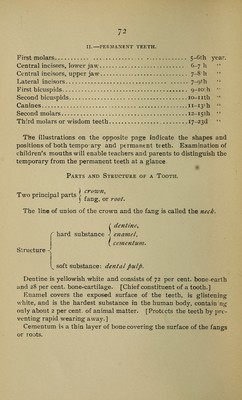
![II.—PERMANENT TEETH. First molars 5-6th year. Central incisors, lower jaw 6-7 h '' Central incisors, upper jaw 7-8' h '' Lateral incisors 7-91 h First bicuspids 9-10.h Second bicuspids io-nth Canines 11-13'h Second molars 12-15 ih '' Third molars or wisdom teeth ij-2^6. '' The illustrations on the opposite page indicate the shapes and positions of both tempo- ary and permanent teeth. Examination of children's mouths will enable teachers and parents to distinguish the temporary from the permanent teeth at a glance Parts and Structure of a Tooth. „ . . - , ) crown, Two principal parts V , r j fang, or root. The line of union of the crown and the fang is called the neck. ( dentine, C hard substance -j enamel, ( cementum. Structure -I I 1^ soft substance: dental pulp. Dentine is yellowish white and consists of 72 per cent, bone-earth and 28 per cent, bone-cartilage. [Chief constituent of a tooth.] Enamel covers the exposed surface of the teeth, is glistening white, and is the hardest substance in the human body, contain ng only about 2 per cent, of animal matter. [Protects the teeth by pre- venting rapid wearing away.] Cementum is a thin layer of bone covering the surface of the fangs or roots.](https://iiif.wellcomecollection.org/image/b21228711_0078.jp2/full/800%2C/0/default.jpg)