Animal models of inherited metabolic diseases : proceedings of the International Symposium on Animal Models of Inherited Metabolic Disease held in Bethesda, Maryland, October 19-20, 1981 / editors: Robert J. Desnick, Donald F. Patterson, Dante G. Scarpelli.
- International Symposium on Animal Models of Inherited Metabolic Disease (1981 : Bethesda, Md.)
- Date:
- [1982]
Licence: Attribution-NonCommercial-NoDerivatives 4.0 International (CC BY-NC-ND 4.0)
Credit: Animal models of inherited metabolic diseases : proceedings of the International Symposium on Animal Models of Inherited Metabolic Disease held in Bethesda, Maryland, October 19-20, 1981 / editors: Robert J. Desnick, Donald F. Patterson, Dante G. Scarpelli. Source: Wellcome Collection.
62/552 page 37
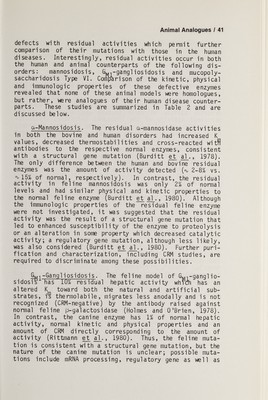
![may partially or totally impair catalytic function. These mutations can be CRM-positive or negative depending on whether they alter the antigenic sites. Missense mutations also can affect the physical stability of the enzyme by altering its conformation or subunit interactions. Un stable proteins may be rapidly degraded by cellular prote ases resulting in non-catalytic, CRM-negative mutations. In the future, it is likely that these mutations will be characterized at the genic level using sophisticated nucleic acid and recombinant DNA techniques. The precise molecular defects (e.g., specific base substitutions, deletions, etc.) in each of the lysosomal storage diseases (and their subtypes and variants) will be identified, analogous to the recent accomplishments in the dissection of the molecular pathology of the human hemoglobinopathies and thalassemias (Kan et_ al_., 1975; Wetherall and Clegg, 1979; Kantor et_ al_., 1980; Proudfoot ejt al_., 1980). At present, such studies are not possible for the lysosomal storage diseases since none of the genes have been isolated and cloned. Recently, a variety of strategies have evolved for the isolation of eukaryotic genes which are expressed at ex tremely low levels. One approach involves the use of synthetic oligonucleotides for priming the synthesis of a cDNA specific for the gene in question or, alternatively, to directly screen cloned cDNA libraries for a segment corresponding to the gene's mRNA (Wallace et_ al_., 1980). The first step toward this goal is the determination of the amino acid sequence of each enzyme and the construction of a DNA oligonucleotide probe. The availability of an oligo nucleotide probe also would permit the analysis of CRM-neg ative mutations by establishing the absence, presence or quantity of mRNA and DNA present in cells of the mutant genotype (Szostak et a]_., 1979). Such studies would iden tify gene deletions or mRNA processing defects. Since the exact molecular defects in the human lyso- sosmal storage diseases cannot be determined at the genic level as yet, efforts have focused on the characterization of the enzymatic defects, particularly in those disorders with detectable residual activity. Information concerning the nature of a mutation which results in a partially active enzyme can be obtained by comparison of the kinetic and physical properties of the normal and residual activ](https://iiif.wellcomecollection.org/image/b18027842_0063.JP2/full/800%2C/0/default.jpg)