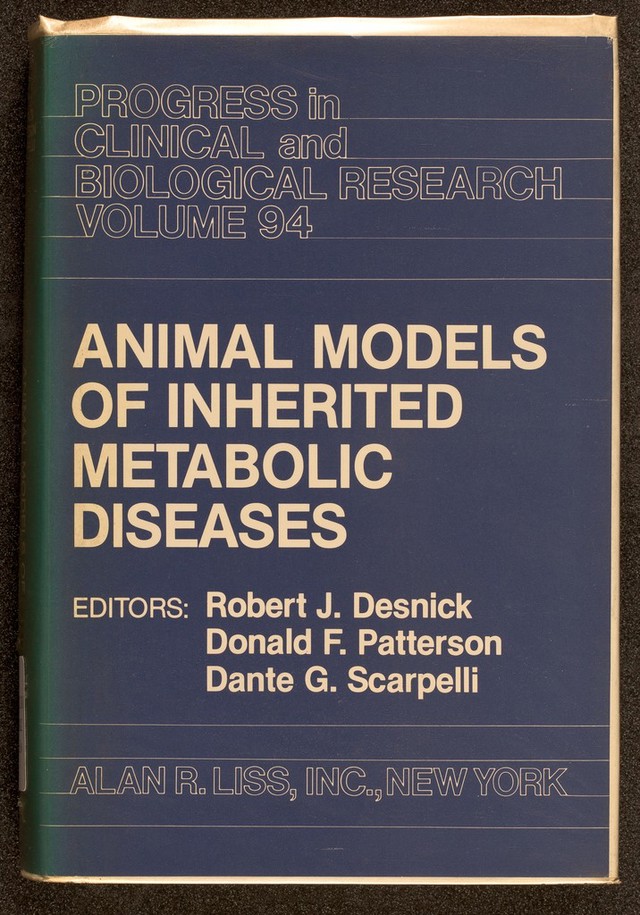
Animal models of inherited metabolic diseases : proceedings of the International Symposium on Animal Models of Inherited Metabolic Disease held in Bethesda, Maryland, October 19-20, 1981 / editors: Robert J. Desnick, Donald F. Patterson, Dante G. Scarpelli.
- International Symposium on Animal Models of Inherited Metabolic Disease (1981 : Bethesda, Md.)
- Date:
- [1982]
Licence: Attribution-NonCommercial-NoDerivatives 4.0 International (CC BY-NC-ND 4.0)
Credit: Animal models of inherited metabolic diseases : proceedings of the International Symposium on Animal Models of Inherited Metabolic Disease held in Bethesda, Maryland, October 19-20, 1981 / editors: Robert J. Desnick, Donald F. Patterson, Dante G. Scarpelli. Source: Wellcome Collection.
73/552 page 48
![strategies for human neurologie disorders. Allotransplantation. An intriguing means for transferring normal genetic information into individuals with certain structural and metabolic gene defects is allotransplantation (Matas et al., 1978a; Matas et_ a]_., 1978b; Hirschhorn, 1980; Desnick and Grabowski, 1981). This approach exploits the grafting of cells, tissues or organs containing the normal DNA for the production of functional gene products in the recip ient. Experimental transplantation designed to correct inborn errors of metabolism has been undertaken in only a few animal disorders. Mukherjee et al_. (1973) reported that orthotopic liver grafts resulted in increased UDP- glucuronyl transferase activity and markedly decreased the hyperbilirubinemia in Gunn rats. Subsequently, Sutherland and co-workers (1977) administered isolated liver cells into the portal vein of Gunn rats and demonstrated de creased levels of plasma bilirubin. Animal model studies have provided the rationale for allogenic bone marrow transplantation for disorders in which the primary disease pathology results from defects in lymphocytes, phagocytes, erythrocytes or platelets. For example, cyclic neutropenia, which occurs in both man and dogs, is thought to be due to a regulatory defect which affects the pluripotential stem cells. Marrow transplant ation in dogs with this disease resulted in normal granulo cytopoiesis and corrected the neutrophil defect (Dale and Graw, 1974). It should also be noted that bone marrow stem cells are the progenitors of other mesodermal cell types, including Kupffer cells and osteoclasts. Thus, successful transplantation of normal stem cells will provide a con tinuous source of differentiated cells for the correction of disorders in which the differentiated cell is the target site of disease pathology. For example, congenital severe osteopetrosis is a recessively inherited disorder of humans characterized by the progressive deposition of bone matrix leading to blindness, deafness, anemia, frequent fractures, increased susceptibility to infection and progressive hepatosplenomegaly. Studies of the molecular pathology of the murine analogue for this disease revealed that the](https://iiif.wellcomecollection.org/image/b18027842_0074.JP2/full/800%2C/0/default.jpg)