On hanging : considered from a mechanical and physiological point of view / by Samuel Haughton.
- Samuel Haughton
- Date:
- [1866]
Licence: Public Domain Mark
Credit: On hanging : considered from a mechanical and physiological point of view / by Samuel Haughton. Source: Wellcome Collection.
Provider: This material has been provided by The Royal College of Surgeons of England. The original may be consulted at The Royal College of Surgeons of England.
5/13 (page 4)
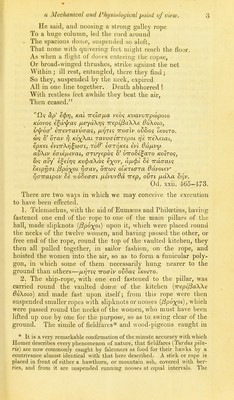
![nooses hanging from a rope stretched from tree to tree, and placed in the passage to their roost, seems rather to favour the second interpretation, which is also aided by the words w? aiy e^eirj<i Ke<pa\a^ e%ov, as if the women hung, like Eluebeard's wives, tit tat toe, all in a row \ It can be shown, from mechanical considerations, that the first interpretation of this remarkable passage is not admissible; for, on the most favourable arrangement of the rope allowable, it would not have been possible for Telemachus, Eumseus, and Philoetius, even if aided by the man that bent the bow, and by the willing Euryclea, to have exerted the force necessary to lift all the women into the air together. The mechanical pro- blem is also worth investigating for its own sake. I shall assume, in order to simplify the conditions, that the women are hung at equal distances along the rope, and that the part of the rope joining the two lowest women is horizontal. These suppositions are very natural, and have the advantage of rendering the solution more elegant, without interfering seriously with its generality. Let a,^,... Uq denote the angles made by the several por- tions of the rope (reckoned from the top) with the horizon. Let Tj, Tg,... Tg denote the strain on each portion of the rope. Let T7=X be the strain on the lowest or horizontal portion of the rope. Let W denote the weight of one of the women. As the second half of the rope is supposed to be symmetrical for the present, there are thirteen unknown quantities to be found, viz. the six angles and seven tensions. Prom the well- known principles of equilibrium of the funicular polygon, we obtain the following twelve equations, which are all mechanical:— T, cosa];=T2COsa2J (1) TgCOSagrrrTgCOSag, (2) Tg COS «g=T4 COS (3) T4COSa4 = T5COSa5, • (4) T5COS a5 = TgC0S ag, • . (5) TgCos«6=T7=X. (6) fieldfares (/ci'p^Xat ravva-iirTepoi), in trying to fly at the berries, are stopped by their broad wings in passing through the nooses, and ai-e so caught by the neck, or occasionally by the foot, but most frequently by the neck; and the stratagem is so successful with this bird, that they are often found hanging in a row from the stick, each suspended by the noose that passes round his neck.](https://iiif.wellcomecollection.org/image/b22282889_0006.jp2/full/800%2C/0/default.jpg)