Report on epidemic cholera and yellow fever in the Army of the United States, during the year 1867 / By Brevet Lieut. Col. J.J. Woodward.
- Joseph Janvier Woodward
- Date:
- 1868
Licence: Public Domain Mark
Credit: Report on epidemic cholera and yellow fever in the Army of the United States, during the year 1867 / By Brevet Lieut. Col. J.J. Woodward. Source: Wellcome Collection.
Provider: This material has been provided by London School of Hygiene & Tropical Medicine Library & Archives Service. The original may be consulted at London School of Hygiene & Tropical Medicine Library & Archives Service.
184/210 page 138
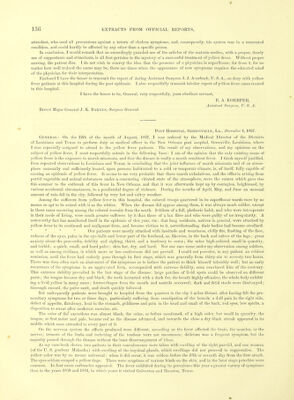
![gas, produced by burning sulphur, nnce 'witli the addition of nitrate of potassa, always requiring them to expose their bedding and clothing as much as possible to the fumes. Once a week I used Dr. Clement's method of burning the spirit of chlorate of copper, filling the wards with the vapor. Although there have been cases of cholera daily for months, we have had no case among our troops originating here, and only three in all, taken in the city when on duty there. I am not prepared to say that yellow fever would not have become epidemic among us without the intercourse referred to; but there is foundation for the belief that if it had been so at all, it vt'ould have been later and less general. I made no autopsies; and as to successful methods of treatment, I do not know that I have anything to write. I am persuaded, after passing through two epidemics, that when premonitory symptoms occur, and during the first stage Of the disease, much more can be done with nwdicine than at any other stage. Few of all these troops were not on the sick list with the fever, and many not sent to the hospital were treated in quarters, where the disease was prevented or aborted by the use of purgatives and quinine, passing from the first stage of the disease to duty in a few days. In none of these cases was there a return of the disease or relapse, with but one exception, No. 12, on list of white patients. After recovery, he had h'ave of absence, indulged in very lieai'ty eating while in the city, and next day was reattacked. He was immediately sent to hospital and died that night. I preferred castor oil as a purgative, but in many cases, six hours before giving it, used three compound cathartic pills. I gave quinine soon after the first operation of the piu'gatives, and at sueli intervals as to give at least thirty grains within twenty-four hours. I preferred, especially if there was irritability of the stomach, to give the quinine in pills, made by mixing the quinine with aromatic sulphuric acid. As to treatment during the progress of the disease, it hardly comes within the scope of this com munication to describe it. I will say, however, that I think quinine is too little administered, because we have been so often told that it has done harm. In my own case, in which the attack was severe, and my liability to miasmatic fever gave reason to appre- hend the result, I took thirty grains daily, and in five days I was able to get up, and in ten I returned to duty. I administered it in the same way to three of the U. S. band whom I treated in private quarters, all of whom recovered. Their drum major was one of them—one of the worst cases I saw—and when his stomach was too irritable to retain anything, I gave him 20 grains twice a day in beef tea enemata; in fourteen days he returned to duty. In all the cases in which I had entire control I gave it as I thought opportunity presented or indications suggested, and always, it appeared to me, with benefit. When a stimulant was needed, after carefully trying champagne, porter, and ale, I gave up all for brandy, finding it to serve the purpose well without the evil results sometimes following the use of the others. In one case of marked interest, extending through nearly two months, in which there were two relapses, and constitutional effects seldom seen without a fatal result—when the stomach was so irritable that it often rebelled against everything; the patient delirious; the pulse 130, but very weak—two to four times a day enemata of beef tea wei'e administered, when I would put in one to two tablespoonfuls of brandy, with ten grains of (]uinine, with an almost immediate reduction of the pulse to eighty with an increase of force. Thus he was carried over a condition which disallowed the use of any food or medicine except by enema. Very respectfully, your obedient servant, WM. DEAL, Acting Assistant Suryeon, U. S. A. Brevet Brigadier General T. A. McPaklin, Medical Director Fifth Military District. QuARAXTiNE Station, Mi.ssissirpi RtVEU, April 20, 1808. Deak Sir : In answer to your communication of the IGth instant, I have to state that the iirst appearance of yellow fever at this station during the year 1867 was on July 1st, four cases arriving on the brig Virgmius from Havana—eight days' passage. During their detention two other cases occurred. The crew was composed of unacclimated Spaniards. The number of cases treated in this hospital during the season was thirty-five, eight of whom died. In reference to the extent to which it prevailed in this vicinity, I learn there were about forty cases, in none of which, however, could the disease be traced to this station ; the history of the cases plainly indicating New (Irleans as the source of infection. The disease did not rage as an epidemic, but when introduced into a dwelling by one of the family having received it elsewhere, it generally extended throughout the family, I have not been able to collect the information you desired some time since in regard to its history in Havana and Vera Cruz, but have written to the United States consuls at those ports, whose replies, I trust, will soon arrive and prove satisfactory. Very respectfully, yours, &c., H. HEILNER, M. D., Resident Physician. Brevet Brigadier General T. A. McParlin, Medical Director Fifth Militarij District.](https://iiif.wellcomecollection.org/image/b21366044_0184.jp2/full/800%2C/0/default.jpg)