Report on epidemic cholera and yellow fever in the Army of the United States, during the year 1867 / By Brevet Lieut. Col. J.J. Woodward.
- Joseph Janvier Woodward
- Date:
- 1868
Licence: Public Domain Mark
Credit: Report on epidemic cholera and yellow fever in the Army of the United States, during the year 1867 / By Brevet Lieut. Col. J.J. Woodward. Source: Wellcome Collection.
Provider: This material has been provided by London School of Hygiene & Tropical Medicine Library & Archives Service. The original may be consulted at London School of Hygiene & Tropical Medicine Library & Archives Service.
98/210 page 52
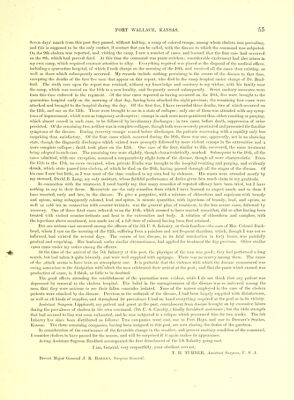
![DETACH:?IE]\T of the ytli CAVAERY, near fort WAEEACE, KANSAS. Headquarters 7th U. S. Cavalry, in the Field, Kear Fort Wallace, Kansas, July 22, 1867. General: I have the honor to inform you that cholera has made its appearance in this command. I was called, about 11 o'clock this day, to see Private Bye, Company H, 7th Cavalry, whom I found lying under a tree near camp suffering terribly from cramps in the abdomen and legs, attended with incessant vomiting and purging of rice-water fluid, excessive pros- tration, cold and clammy skin, nose icy cold, pulse entirely gone at tlie wrist, general cyanosis, pupils contracted, coma; could be roused, but would immediately fall away into deep sleep; urine suppressed, and features collapsed. I would respectfully add that cholera first presented itself near new Fort Hays, Kansas, about 4 p. m, July 11th, 1867, in the person of a citizen belonging to a citizen train which came from Salina, Kansas, with supplies for a trader near camp. The man was at least three-quarters of a mile from camp, and was not brought into or near it, although removed to a more suitable place than the one he occupied. A colored soldier was also taken with the disease the same night. They both (soldier and citizen) died next morning. Our detachment of cavalry was some distance from the colored troops, (for the camp was large,) and communication between them, after the disease broke out in camp, did not exist. We left new Fort Hays, Kansas, about 1 p. m., July I'Zth, up to which time no symptoms of cholera had appeared among the men of the detachment. The water at the first station west of Fort H.ays is very bad, the drinking of which caused several cases of acute diarrhoea, but no symptoms of cholera were visible while on the march from Fort Hays to this camiJ, and the time occupied was seven days. That the disease was brought here, I am perfectly satisfied, for the men of the government and citizen trains at Fort Hays had constant intercourse with each other; besides, some of the same men, belonging to the government train at Fort Hays, came to this camp with property belonging to the 7tli Cavalry at the same time that the detachment did. That the disease which has broken out at this camp is true Asiatic cholera, I have not the least doubt; and I am fully supported in my diagnosis by Dr. Coates, who is on duty with the regiment. I have the honor to be, General, very respectfully, your obedient servant, HENRY LIPPINCOTT, Assistant Surgeon, U. S. A. Brevet Major General J. K. Barnes, Surgeon General. Headquarters 7tii U. S. Cavalry, in the Field, Near Fort Wallace, Kansas, 10 o'cloc^k p. m., July 25, 1867. General : I have the honor to infonn you that cholera is on the increase in this camp. I have just recorded (9 o'clock p.m.) the tenth case of the disease, and the fourth death. At surgeon's call this morning we had seven cases of diarrhoea; the latter not severe, however. Two quartei-master's employes and one Indian scout are included in the cases of cholera above mentioned. I would respectfully recall your attention to the fact that cholera did not present itself among the men of the detach- ment of the 7th U. S. Cavalry while on the march fi'om Fort Hays, Kansas, to this camp, and the time occupied in coming from that post to this camp was seven days. As cholera had only broken out at new Fort Hays, Kansas, on the evening of July 11th, 1867, and as we left that post the next day about 1 o'clock p. m., and as we were on the road seven days without any signs of cholera arising, it was not considered necessary to go into quarantine after our arrival at this camp. Every eflbrt is being made to arrest the progress of the disease, and I hope I shall be able to malte a more favorable report very soon. I have the honor to be, General, very respectfully, your obedient servant, HENRY LIPPINCOTT, Assistant Sunjeon, U. S. A. Brevet Major General J. K. Barnes, Surgeon General. Headquarters 7th U. S. Cavalry, in the Field, Near Fort Wallace, Kansas, 11 o'clock a.m., July 27, 1867. General : I have the honor to report that cholera is decreasing in this camp, .ilthough we have had one new case and four deaths since my last report. All the fatal cases seemed to begin with death* Despite every effort to avert or prevent it, disso- lution was inevitable, death supervening in from 6 to 15 hours. It will be seen, by referring to my foi'uier reports, that I believed the disease was brought here by human agency. I still adhere to the same opinion. But for the benefit of those who do not give credence to the import.ition of cholera from infected points, I would respectfully state that a part of the 7th Cavalry left Fort Hays, Kansas, June 1st, 1867, on an expedition to the Platte river, and after marching over seven hundred miles, subjected to great exposure, eating bad and insufficient food, drinking impure and often a too limited supply of water, arrived at this point July 13th, 1867. The detachment of 7th U. S. Cavalry and quartermaster's train from Fort Hays, Kansas, arrived here July 18th, 1867, and a citizen train came in next day with supplies for the post. Cholera broke out on the 22d, and was and still is confined to the soldiers and employ6s who were on the expedition to the Platte river, f o Major Elliott, the present commanding officer, much credit is due in arresting the progress of the disease. His promptness in having wells dug, at my suggestion; making many daily inspections of the men ; causing the grounds around the wells and quarters to be kept clean; sinks to be inspected and filled](https://iiif.wellcomecollection.org/image/b21366044_0098.jp2/full/800%2C/0/default.jpg)