Some recently discovered letters of William Harvey, with other miscellanea / by S. Weir Mitchell ; with a bibliography of Harvey's works by Charles Perry Fisher.
- William Harvey
- Date:
- 1912
Licence: Public Domain Mark
Credit: Some recently discovered letters of William Harvey, with other miscellanea / by S. Weir Mitchell ; with a bibliography of Harvey's works by Charles Perry Fisher. Source: Wellcome Collection.
Provider: This material has been provided by the Francis A. Countway Library of Medicine, through the Medical Heritage Library. The original may be consulted at the Francis A. Countway Library of Medicine, Harvard Medical School.
20/88 page 6
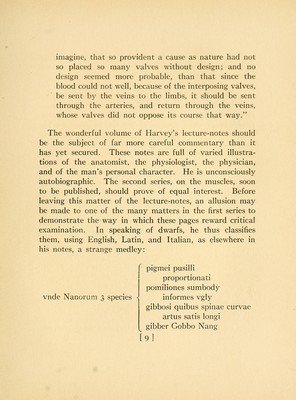
![When Harvey was leaving Padua, in 1602, he placed his well-known stemma on the wall, where he would probably have set his arms had he then possessed them. Certainly, neither Thomas Harvey nor William had any early accredited right to use arms. When they were given this privilege I do not learn from the biographers. One of William Harvey's portraits has in the corner arms which, in the photograph, are not decipherable. A note in W. J. Harvey's paper still leaves this question without satisfactory answer. The first of these very notable Harveys of whom we hear is Thomas, the father of seven sons and two daughters. He lived in the little seaside village of Folkestone, in Kent, was sometime alderman and mayor, and was described in the books of Caius College, Cambridge, when his son entered, as yeoman. There could have been no large commerce in the little seaport town, and whether Harvey the yeoman had landed property or not could, I presume, be ascertained. It is just possible that the fisheries, a great business in those days, may have had to do with the ample means Thomas Harvey must have acquired. To educate William at Cambridge and to give him four years at Padua involved much expense, nor could he as a physician have been able to support himself during his early years of life in London. Before or after Thomas Harvey removed to London, in 1605, he apprenticed five of his younger sons to Turkey merchants, paying, of course, the fees exacted for receiving apprentices. When later they became [6]](https://iiif.wellcomecollection.org/image/b21173370_0020.jp2/full/800%2C/0/default.jpg)