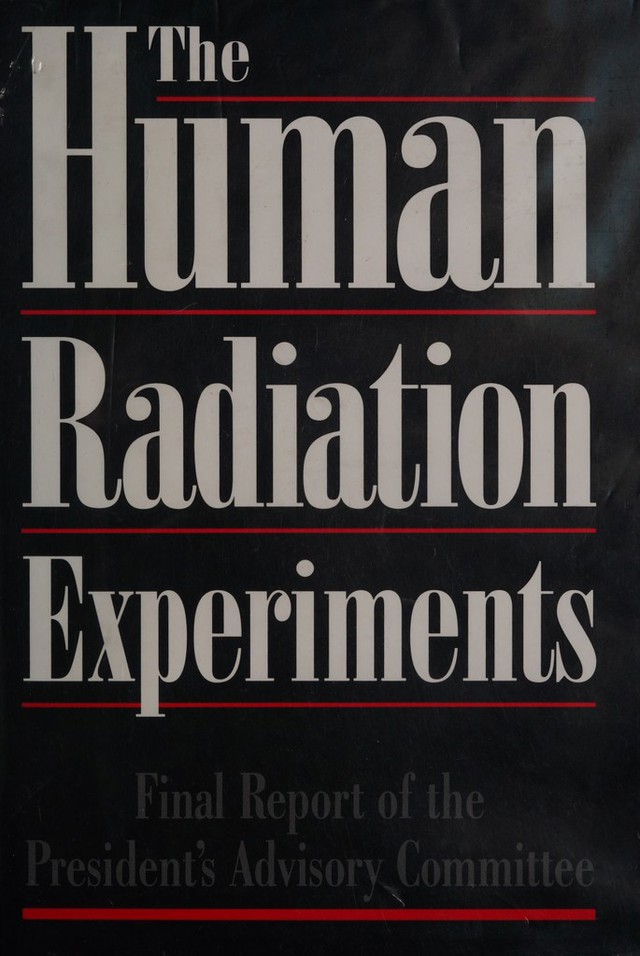
Final report of the Advisory Committee on Human Radiation Experiments.
- United States. Advisory Committee on Human Radiation Experiments
- Date:
- 1996
Licence: Public Domain Mark
Credit: Final report of the Advisory Committee on Human Radiation Experiments. Source: Wellcome Collection.
40/662 page 4
![survival rates for patients with a variety of cancers. Fractionation became, and remains, an accepted approach to cancer treatment.!! Along with better understanding of radi- ation’s benefits came a better practical apprecia- tion of its dangers. Radiation burns were quickly apparent, but the greater danger took longer to manifest itself. Doctors and researchers were fre- quently among the victims. Radiation research- ers were also slow to take steps to protect them- selves from the hidden danger. One journal opened its April 1914 issue by noting that “[w]e have to deplore once more the sacrifice of a radi- ologist, the victim of his art.”!? Clear and early evidence of tragic results sharp- ened both expert and public concern. By 1924, a New Jersey dentist noticed an unusual rate of deterioration of the jawbone among local women. On further investigation he learned that all at one time had jobs painting a radium solu- tion onto watch dials. Further studies revealed that as they painted, they licked their brushes to maintain a sharp point. Doing so, they absorbed radium into their bodies. The radium gradually revealed its presence in jaw deterioration, blood disease, and eventually, a painful, disfiguring deterioration of the jaw.'’ There was no question that radium was the culprit. The immediate out- come was a highly publicized crusade, investi- gation, lawsuits, and payments to the victims. Despite the publicity surrounding the dial paint- ers, response to the danger remained agonizingly slow. Patent medicines containing radium and radium therapies continued.!4 The tragedy of the radium dial painters and similar cases of patients who took radium nos- trums have provided basic data for protection standards for radioactive substances taken into the body. One prominent researcher in the new area of radiation safety was Robley Evans. Evans was drawn into the field by the highly publicized death in 1932 of Eben Byers, following routine consumption of the nostrum Radiothor. Byers’s death spurred Evans, then a California Institute of Technology physics graduate student, to un- dertake research that led to a study of the effects on the body of ingesting radium; this study would continue for more than half a century.!? Evans’s study and subsequent studies of the effects of radium treatments provided the anchor in human data for our understanding of the ef- fects of radiation within the human body. As the dangers of the imprudent use of x rays and in- ternal radiation became clear, private scientific advisory committees sprang up to develop vol- untary guidelines to promote safety among those working with radiation. When the government did enter the atomic age, it often referred to the guidelines of these private committees as it de- veloped radiation protection standards.!¢ The Miracle of Tracers In 1913, the Hungarian chemist Georg von Hevesy began to experiment with the use of ra- dioactive forms of elements (radioisotopes) to trace the behavior of the normal, nonradioactive forms of a variety of elements. Ten years later Hevesy extended his chemical experiments to biology, using a radioisotope of lead to trace the movement of lead from soil into bean plants. In 1943, Hevesy won the Nobel Prize for his work on the use of radioisotopes as tracers. Previously, those seeking to understand life processes of an organism had to extract mole- cules and structures from dead cells or organ- isms, and then study those molecules by arduous chemical procedures, or use traceable chemicals that were foreign to the organism being studied but that mimicked normal body chemicals in some important way. Foreign chemicals could alter the very processes being measured and, in any case, were often as diffi- cult to measure precisely as were normal body constituents. The radioactive tracer—as Our Friend the Atom, a book written by Dr. Heinz Haber for Walt Disney productions, explained in 1956 to readers of all ages—was an elegant alternative: “Making a sample of material mildly radioactive is like putting a bell on a sheep. The shepherd traces the whole flock around by the sound of the bell. In the same way it is possible to keep tabs on tracer-atoms with a Geiger counter or any other radiation detector.”!’ By the late 1920s the tracer technique was being applied to humans in Boston by research- ers using an injection of dissolved radon to mea- sure the rate of blood circulation, an early example of using radioactivity to observe life processes. !® However, research opportunities were](https://iiif.wellcomecollection.org/image/b32220558_0040.jp2/full/800%2C/0/default.jpg)