Climate : an inquiry into the causes of its differences, and into its influence on vegetable life : comprising the substance of four lectures delivered before the Natural History Society, at the Museum, Torquay, in February, 1863 / by C. Daubeny.
- Daubeny, Charles Giles Bridle, 1795-1867.
- Date:
- 1863
Licence: Public Domain Mark
Credit: Climate : an inquiry into the causes of its differences, and into its influence on vegetable life : comprising the substance of four lectures delivered before the Natural History Society, at the Museum, Torquay, in February, 1863 / by C. Daubeny. Source: Wellcome Collection.
Provider: This material has been provided by The Royal College of Surgeons of England. The original may be consulted at The Royal College of Surgeons of England.
112/165
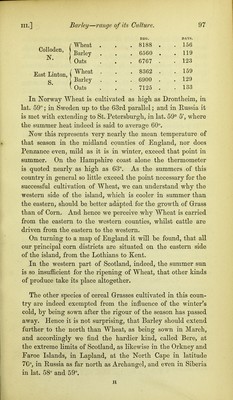
![DEG. DAYS. . 8188 . . 156 . 6560 . . 119 . 6767 . . 123 . 8362 . . 159 . 6900 . . 129 . 7125 . . 133 In JN'orway Wheat is cultivated as high, as Drontheim, in lat. 59°; in Sweden up to the 63rd parallel; and in Eussia it is met with extending to St. Petersburgh, in lat. 59° 5', where the summer heat indeed is said to average 60°. ]N^ow this represents very nearly the mean temperature of that season in the midland counties of England, nor does Penzance even, mild as it is in winter, exceed that point in summer. On the Hampshire coast alone the thermometer is quoted nearly as high as 63°. As the summers of this country in general so little exceed the point necessary for the successful cultivation of Wheat, we can understand why the western side of the island, which is cooler in summer than the eastern^ should be better adapted for the growth of Grass than of Corn. And hence we perceive why Wheat is carried from the eastern to the western counties, whilst cattle are driven from the eastern to the western. On turning to a map of England it will be found, that all our principal corn districts are situated on the eastern side of the island, from the Lothians to Kent. In the western part of Scotland, indeed, the summer sun is so insufficient for the ripening of Wheat, that other kinds of produce take its place altogether. The other species of cereal Grasses cultivated in this coun- try are indeed exempted from the influence of the winter's cold, by being sown after the rigour of the season has passed away. Hence it is not surprising, that Barley should extend further to the north than Wheat, as being sown in March, and accordingly we find the hardier kind, called Bere, at the extreme limits of Scotland, as likewise in the Orkney and Earoe Islands, in Lapland, at the North Cape in latitude 70°, in Russia as far north as Archangel, and even in Siberia in lat. 58° and 59°. H CoUoden, (-r, f ^ Barley ^- I Oats East Linton, (^^^^* g { Barley Oats](https://iiif.wellcomecollection.org/image/b22270012_0113.jp2/full/800%2C/0/default.jpg)