UK climate change programme : memoranda relating to the inquiry submitted to the Committee / Environment, Transport and Regional Affairs Committee.
- Great Britain. Parliament. House of Commons. Environment, Transport, and Regional Affairs Committee
- Date:
- 1999
Licence: Open Government Licence
Credit: UK climate change programme : memoranda relating to the inquiry submitted to the Committee / Environment, Transport and Regional Affairs Committee. Source: Wellcome Collection.
20/112 page 14
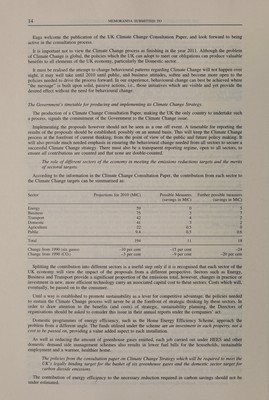
![Eaga welcome the publication of the UK Climate Change Consultation Paper, and look forward to being active in the consultation process. It is important not to view the Climate Change process as finishing in the year 2011. Although the problem of Climate Change is global, the policies which the UK can adopt to meet our obligations can produce valuable benefits to all elements of the UK economy, particularly the Domestic sector. It must be realised the attempt to change behavioural patterns regarding Climate Change will not happen over night, it may well take until 2010 until public, and business attitudes, soften and become more open to the policies needed to drive the process forward. In our experience, behavioural change can best be achieved where “the message” is built upon solid, passive actions, 1.e., those initiatives which are visible and yet provide the desired effect without the need for behavioural change. The Government’s timetable for producing and implementing its Climate Change Strategy. The production of a Climate Change Consultation Paper, making the UK the only country to undertake such a process, signals the commitment of the Government to the Climate Change issue. Implementing the proposals however should not be seen as a one off event. A timetable for reporting the results of the proposals should be established, possibly on an annual basis. This will keep the Climate Change process at the forefront of current thinking, from the point of view of the public and future policy making. It will also provide much needed emphasis in ensuring the behavioural change needed from all sectors to secure a successful Climate Change strategy. There must also be a transparent reporting regime, open to all sectors, to ensure all contributions are counted and that none are double-counted. The role of different sectors of the economy in meeting the emissions reductions targets and the merits of sectoral targets. According to the information in the Climate Change Consultation Paper, the contribution from each sector to the Climate Change targets can be summarised as: Sector Projections for 2010 (MtC) Possible Measures _ Further possible measures (savings in MtC) (savings in MtC) Energy 59 0 5 Business Ws 3 li Transport 42 4 2 Domestic 4] 3 %4 Agriculture 22 0.5 0 Public 9.4 0.5 0.6 Total 194 11 18 Change from 1990 (six gases) —10 per cent —15 per cent —24 Change from 1990 (CO,) —3 per cent —9 per cent —20 per cent Splitting the contribution into different sectors is a useful step only if it is recognised that each sector of the UK economy will view the impact of the proposals from a different perspective. Sectors such as Energy, Business and Transport provide a significant proportion of the emissions total, however, changes in practice or investment in new, more efficient technology carry an associated capital cost to these sectors. Costs which will, eventually, be passed on to the consumer. Until a way is established to promote sustainability as a lever for competitive advantage, the policies needed to sustain the Climate Change process will never be at the forefront of strategic thinking by these sectors. In order to draw attention to the benefits (and costs) of strategic, sustainability planning, the Directors of organisations should be asked to consider this issue in their annual reports under the companies’ act. Domestic programmes of energy efficiency, such as the Home Energy Efficiency Scheme, approach the problem from a different angle. The funds utilised under the scheme are an investment in each property, not a cost to be passed on, providing a value added aspect to each installation. As well as reducing the amount of greenhouse gases emitted, each job carried out under HEES and other domestic demand side management schemes also results in lower fuel bills for-the households, sustainable employment and a warmer, healthier home. The policies from the consultation paper on Climate Change Strategy which will be required to meet the UK’s legally binding target for the basket of six greenhouse gases and the domestic sector target for carbon dioxide emissions. The contribution of energy efficiency to the necessary reduction required in carbon savings should not be under estimated. “](https://iiif.wellcomecollection.org/image/b32221009_0020.jp2/full/800%2C/0/default.jpg)



 No text description is available for this image
 No text description is available for this image
 No text description is available for this image