UK climate change programme : memoranda relating to the inquiry submitted to the Committee / Environment, Transport and Regional Affairs Committee.
- Great Britain. Parliament. House of Commons. Environment, Transport, and Regional Affairs Committee
- Date:
- 1999
Licence: Open Government Licence
Credit: UK climate change programme : memoranda relating to the inquiry submitted to the Committee / Environment, Transport and Regional Affairs Committee. Source: Wellcome Collection.
43/112 (page 37)
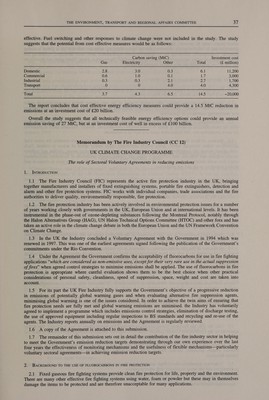
![effective. Fuel switching and other responses to climate change were not included in the study. The study suggests that the potential from cost effective measures would be as follows: Carbon saving (MtC) Investment cost Gas Electricity Other Total (£ million) Domestic 2.8 3.0 0.3 6.1 11,200 Commercial 0.6 1.0 0.1 1.7 3,000 Industrial 0.3 0.3 Prd | PGI 1,700 Transport 0 0 4.0 4.0 4,300 Total oa 4.3 6.5 14.5 ~20,000 The report concludes that cost effective energy efficiency measures could provide a 14.5 MtC reduction in emissions at an investment cost of £20 billion. Overall the study suggests that all technically feasible energy efficiency options could provide an annual emission saving of 27 MtC, but at an investment cost of well in excess of £100 billion. Memorandum by The Fire Industry Council (CC 12) UK CLIMATE CHANGE PROGRAMME The role of Sectoral Voluntary Agreements in reducing emissions 1. INTRODUCTION 1.1 The Fire Industry Council (FIC) represents the active fire protection industry in the UK, bringing together manufacturers and installers of fixed extinguishing systems, portable fire extinguishers, detection and alarm and other fire protection systems. FIC works with individual companies, trade associations and the fire authorities to deliver quality, environmentally responsible, fire protection. 1.2 The fire protection industry has been actively involved in environmental protection issues for a number of years working closely with governments in the UK, European Union and at international levels. It has been instrumental in the phase-out of ozone-depleting substances following the Montreal Protocol, notably through the Halon Alternatives Group (HAG), UN Halon Technical Options Committee (HTOC) and other fora and has taken an active role in the climate change debate in both the European Union and the UN Framework Convention on Climate Change. 1.3. In the UK the Industry concluded a Voluntary Agreement with the Government in 1994 which was renewed in 1997. This was one of the earliest agreements signed following the publication of the Government’s commitments under the Rio Convention. 1.4 Under the Agreement the Government confirms the acceptability of fluorocarbons for use in fire fighting applications “which are considered as non-emissive uses, except for their very rare use in the actual suppression of fires” when agreed control strategies to minimise emissions shall be applied. The use of fluorocarbons in fire protection is appropriate where careful evaluation shows them to be the best choice when other practical considerations of personal safety, cleanliness, speed of suppression, space, weight and cost are taken into account. 1.5 For its part the UK Fire Industry fully supports the Government’s objective of a progressive reduction in emissions of potentially global warming gases and when evaluating alternative fire suppression agents, minimising global warming is one of the issues considered. In order to achieve the twin aims of ensuring that fire protection needs are fully met and global warming emissions are minimised. the Industry has voluntarily agreed to implement a programme which includes emissions control] strategies, elimination of discharge testing, the use of approved equipment including regular inspections to BS standards and recycling and re-use of the agents. The Industry reports annually on emissions and the Agreement is regularly reviewed. 1.6 A copy of the Agreement is attached to this submission. 1.7 The remainder of this submission sets out in detail the contribution of the fire industry sector in helping to meet the Government’s emission reduction targets demonstrating through our own experience over the last four years the effectiveness of monitoring mechanisms and the usefulness of flexible mechanisms—particularly voluntary sectoral agreements—in achieving emission reduction targets. 2. BACKGROUND TO THE USE OF FLUOROCARBONS IN FIRE PROTECTION 2.1 Fixed gaseous fire fighting systems provide clean fire protection for life, property and the environment. There are many other effective fire fighting systems using water, foam or powder but these may in themselves damage the items to be protected and are therefore unacceptable for many applications.](https://iiif.wellcomecollection.org/image/b32221009_0043.jp2/full/800%2C/0/default.jpg)