Report of the Director of Medical and Sanitary Services / [Ceylon].
- Ceylon. Civil Medical Department
- Date:
- [1927]
Licence: Public Domain Mark
Credit: Report of the Director of Medical and Sanitary Services / [Ceylon]. Source: Wellcome Collection.
83/138 (page 71)
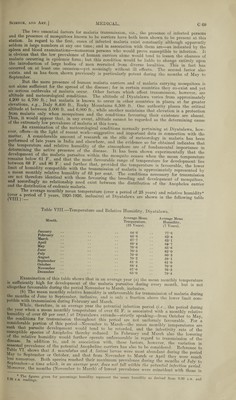
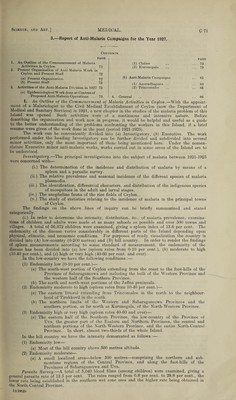
![Science, and Art.] MEDICAL. 3.—Report of Anti-Malaria Campaigns for the Year 1927. C 71 Contents. page 1. An Outline of the Commencement of Malaria Activities in Ceylon . . ..71 2. Present Organization of Anti-Malaria Work in Ceylon and Present Staff . . 72 (а) Present Organization . . 72 (б) Present Staff . . . . 73 3. Activities of the Anti-Malaria Division in 1927 73 (a) Epidemiological Work done at Centres of Proposed Anti-Malaria Operations . . 73 PAGE (1) Chilaw .. ..73 (2) Kurunegala .. 79 (b) Anti-Malaria Campaigns . . 83 (1) Anuradhapura .. ..83 (2) Trineomalee . . .. 85 4. General . . . . 86 1. An Outline of the Commencement of Malaria Activities in Ceylon.—With the appoint¬ ment of a Malariologist to the Civil Medical Establishment of Ceylon (now the Department of Medical and Sanitary Services) in 1921, a new chapter in the studies of the malaria problem of this Island was opened. Such activities were of a continuous and intensive nature. Before describing the organization and work now in progress, it would be helpful and useful as a guide to the better understanding of the problems confronting the workers in this Island, if a brief resume were given of the work done in the past (period 1921-1925). The work can be conveniently divided into (a) Investigatory, (6) Executive. The work performed under the heading Investigatory can be further divided and subdivided into several minor activities, only the most important of them being mentioned here. Under the nomen¬ clature Executive minor anti-malaria works, works carried out in some areas of the Island are to be understood. Investigatory.—The principal investigations into the subject of malaria between 1921-1925 were concerned with— (i.) The determination of the incidence and distribution of malaria by means of a spleen and a parasite survey. (ii.) The relative prevalence and seasonal incidence of the different species of malaria plasmodia. (iii.) The identification, differential characters, and distribution of the indigenous species of mosquitoes in the adult and larval stages. (iv.) The anopheline fauna of the rice fields of Ceylon. (v.) The study of statistics relating to the incidence of malaria in the principal towns of Ceylon. The findings on the above lines of inquiry can be briefly summarized and stated categorically. (i.) In order to determine the intensity, distribution, &c., of malaria prevalence, examina¬ tions of children and adults were made at as many schools as possible and over 500 towns and villages. A total of 56,372 children were examined, giving a spleen index of 13.6 per cent. The endemicity of the disease varies considerably in different parts of the Island depending upon physical, climatic, and economic conditions. For purposes of ready visualization the country is divided into (A) low-country (0-200 metres) and (B) hill country. In order to render the findings of spleen measurements according to some standard of measurement, the endemicity of the disease has been divided into (a) low (spleen rates from 0-10 per cent.), (b) moderate to high (10-40 per cent.), and (c) high or very high (40-60 per cent, and over). In the low-country we have the following conditions : — (1) Endemicity low (0-10 per cent.)— (a) The south-west portion of Ceylon extending from the coast to the foot-hills of the Province of Sabaragamuwa and including the bulk of the Western Province and the western half of the Southern Province. (b) The north and north-west portions of the Jaffna peninsula. (2) Endemicity moderate to high (spleen rates from 10-40 per cent.)— (a) The eastern littoral extending from Trineomalee in the north to the neighbour¬ hood of Tirukkovil in the south. (b) The northern limits of the Western and Sabaragamuwa Provinces and the southern portion, as far north as Kurunegala, of the North-Western Province. (3) Endemicity high or very high (spleen rates 40-60 and over)— (a) The eastern half of the Southern Province, the low-country of the Province of Uva, the greater part of the Eastern and Northern Provinces, the central and northern portions of the North-Western Province, and the entire North-Central Province. In short, almost two-thirds of the whole Island. In the hill country we have the intensity demarcated as follows: — (1) Endemicity low— (a) Most of the hill country above 500 metres altitude. (2) Endemicity moderate— (a) A small localized area—below 500 metres—comprising the northern and sub¬ montane regions of the Central Province, and along the foot-hills of the Provinces of Sabaragamuwa and Uva. Parasite Survey.—A total of 5,040 blood films (among children) were examined, giving a general parasite rate of 13.5 per cent. The rates ranged from 0.8 per cent, to 28.8 per cent., the lower rate being established in the southern wet zone area and the higher rate being obtained in the North-Central Province. 13(39)28](https://iiif.wellcomecollection.org/image/b31753280_0083.jp2/full/800%2C/0/default.jpg)