Licence: In copyright
Credit: Sales catalogue 1: Lathorp C. Harper, Inc. Source: Wellcome Collection.
10/92 page 4
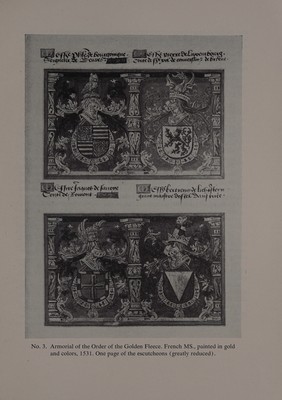
![closing flowers and fruit extending into the margins, together with representations of the following: The Virgin and Child, the Presentation in the Temple, the Three Wise Men, the Resurrection, the Ascension, the Holy Ghost, the Holy Grail, the Annunciation, the Assumption of the Virgin, Saint John the Baptist, SS. Peter and Paul, Saint Augustine, and others. [See Illustrations, verso of Title-page and page 3.] ARMORIAL OF THE ORDER OF THE GOLDEN FLEECE 3. CHRONIQUE et Armorial de l’Ordre de la Toison d’Or, 1429-1531. Manu- script on 58 leaves of vellum, with 5 full-page portraits of the first five heads of the order, five full-page miniatures of their armorial bearings, and 195 armorial escutcheons of all the Knights created from 1429 to 1531; all beautifully painted in gold and colors. Small folio, original sixteenth-century brown sheepskin with gilt ornaments. [France, sixteenth century.] $6,500.00 A REMARKABLE ARMORIAL OF THE CELEBRATED ORDER OF THE GOLDEN FLEECE, Covering the heraldry of its leaders and members during the first 102 years of its existence. The brief text records the holding of all “chapters,” or meetings, from its founding at Bruges in January, 1429, through the 29th Chapter at Tournai in December, 1531. The volume ap- pears to have been executed immediately after the latter date, and to be the work of a French-speaking artist of Burgundy or Brabant who was unfamiliar with the spelling of names in other languages. The “‘Toison d’Or,” or Order of the Golden Fleece, was the most exclusive and coveted order of knighthood in Catholic Europe. Founded by Philip the Good, Duke of Burgundy, it was limited to 30 members of “pure and ancient lineage.” From that time it comprised the foremost nobles of the Burgundian, Habsburg, and Spanish Bourbon courts in suc- cession until the dissolution of the last of these monarchies in recent years. The first five heads of the order, whose full-length portraits appear in this manuscript, were: Philip the Good of Burgundy (died 1467) Charles the Bold of Burgundy (died 1477) Maximilian I, Emperor of the Holy Roman Empire (died 1519) Philip the Handsome (son of Maximilian and heir to Castile and Aragon) (died 1506) Charles V, Emperor and King of Spain (died 1558) The portrait of Charles V, obviously painted from life in 1531, is a work of art of the highest merit. The portraits of the five chiefs show them in the full ceremonial robes of the order: a gown of crimson velvet lined with white taffeta over which is thrown a long crim- son cloak lined with white satin, the head covered with a toque of crimson velvet em- broidered in gold. Each wears the Collar of the order: a golden chain with links designed ret](https://iiif.wellcomecollection.org/image/b33160296_0010.jp2/full/800%2C/0/default.jpg)
 No text description is available for this image
 No text description is available for this image
 No text description is available for this image