Licence: In copyright
Credit: Sales catalogue 1: Lathorp C. Harper, Inc. Source: Wellcome Collection.
13/92 page 7
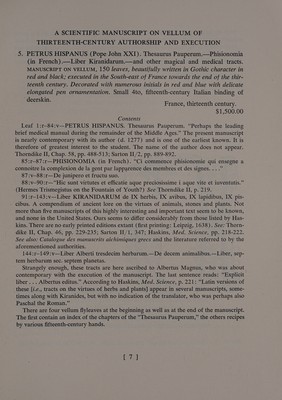
![A SCIENTIFIC MANUSCRIPT ON VELLUM OF THIRTEENTH-CENTURY AUTHORSHIP AND EXECUTION 5. PETRUS HISPANUS (Pope John XXI). Thesaurus Pauperum.—Phisionomia (in French).—Liber Kiranidarum.—and other magical and medical tracts. MANUSCRIPT ON VELLUM, 150 leaves, beautifully written in Gothic character in red and black; executed in the South-east of France towards the end of the thir- teenth century. Decorated with numerous initials in red and blue with delicate elongated pen ornamentation. Small 4to, fifteenth-century Italian binding of deerskin. : France, thirteenth century. $1,500.00 Contents Leaf 1:r-84:v—PETRUS HISPANUS. Thesaurus Pauperum. “Perhaps the leading brief medical manual during the remainder of the Middle Ages.” The present manuscript is nearly contemporary with its author (d. 1277) and is one of the earliest known. It is therefore of greatest interest to the student. The name of the author does not appear. Thorndike I, Chap. 58, pp. 488-513; Sarton IT/2, pp. 889-892. 85 :1—-87:r—PHISIONOMIA (in French). “Ci commence phisionomie qui ensegne a connoitre la complexion de la gent par lapparence des membres et des signes. .. .” 87:v—88 :r—De junipero et fructu suo. 88:v—90:r—“Hic sunt virtutes et efficatie aque preciosissime i aque vite et iuventutis.” (Hermes Trismegistus on the Fountain of Youth?) See Thorndike II, p. 219. 91:r—143:v—Liber KIRANIDARUM de IX herbis, IX avibus, IX lapidibus, IX pis- cibus. A compendium of ancient lore on the virtues of animals, stones and plants. Not more than five manuscripts of this highly interesting and important text seem to be known, and none in the United States. Ours seems to differ considerably from those listed by Has- kins. There are no early printed editions extant (first printing: Leipzig, 1638). See: Thorn- dike II, Chap. 46, pp. 229-235; Sarton II/1, 347; Haskins, Med. Science, pp. 218-222. See also: Catalogue des manuscrits alchimiques grecs and the literature referred to by the aforementioned authorities. 144:r-149:v—Liber Alberti tresdecim herbarum.—De decem animalibus.—Liber, sep- tem herbarum sec. septem planetas. Strangely enough, these tracts are here ascribed to Albertus Magnus, who was about contemporary with the execution of the manuscript. The last sentence reads: “Explicit liber .. . Albertus editus.” According to Haskins, Med. Science, p. 221: “Latin versions of these [i.e., tracts on the virtues of herbs and plants] appear in several manuscripts, some- times along with Kiranides, but with no indication of the translator, who was perhaps also Paschal the Roman.” There are four vellum fiyleaves at the beginning as well as at the end of the manuscript. The first contain an index of the chapters of the “Thesaurus Pauperum,” the others recipes by various fifteenth-century hands. Lela]](https://iiif.wellcomecollection.org/image/b33160296_0013.jp2/full/800%2C/0/default.jpg)
 No text description is available for this image
 No text description is available for this image
 No text description is available for this image