Italy : handbook for travellers. First part, Northern Italy and Corsica / by K. Baedeker.
- Karl Baedeker
- Date:
- 1870
Licence: Public Domain Mark
Credit: Italy : handbook for travellers. First part, Northern Italy and Corsica / by K. Baedeker. Source: Wellcome Collection.
44/494 page 14
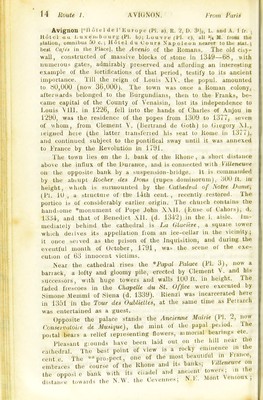
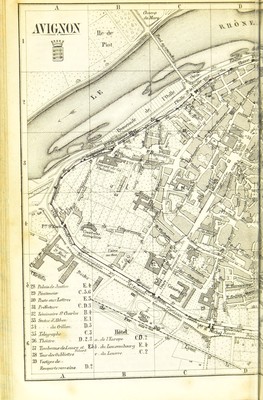
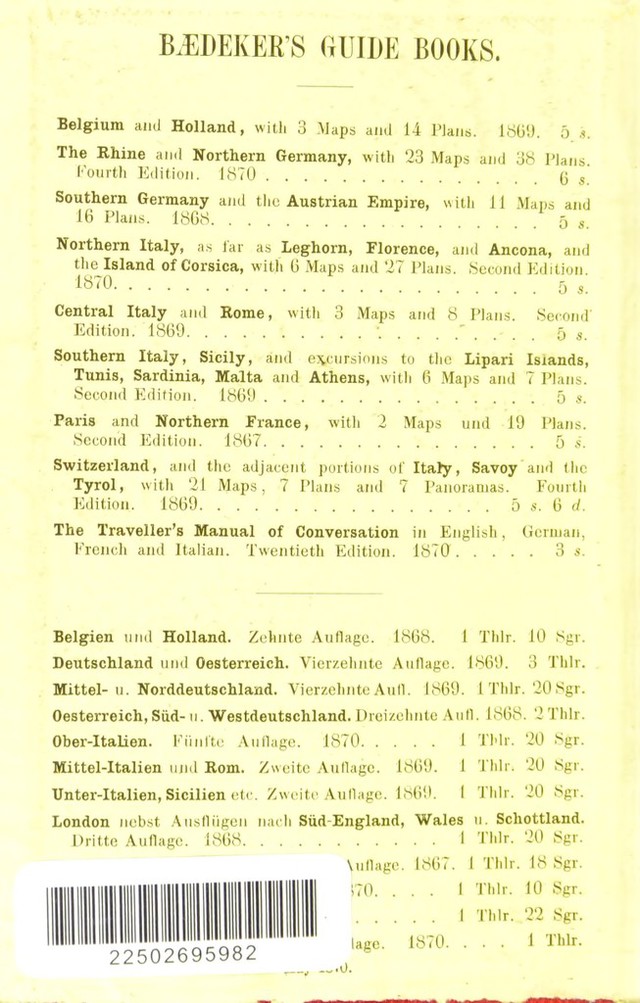
![Avignon I 'll o ( el de r Europe (PI. a), R. 2, U. 3'|i, L. and A. 1 fr. .. Hold an J> ux em bo urj; (P]. b;; ho u v r e (Pi. c}, all »!« M. from the station, omnibus 5U c.; Hotel du Cours Napoleon nearer to the stal.; best Caj^s in the Place], the Avenio of the Romans. The old ci(>- wall, constructed of massive blocks of .stone in 1349—68, with numerous gates, admirably preserved and aflording an interesting example of the iortilicatious of that period, testify to its ancient importance. Till the reign of Louis XIV. the popul. amounted to 80,000 (now 36,000j. The town was once a Roman colony, afterwards belonged to the lUirgundians, then to the Franks, be- came capital of the County of Venaisin, lost its independence to Louis Vlll. in 1226, fell into the hands of Charles of Anjou iu 1290, was the residence of the popes from 1309 to 1377, seven of whom, from Clement Y. (Bertrand de CothJ lo tuegory XL, leigned heie (the latter tiauaferred his seat to Rome in 1377), and continued subject to the pontifical sway until it was annexed to France by the Revolution in 1791. The town lies on the 1. bank of the Rhone, a short distance above the influx of the Durance, and is connected with Villeneuve on the opposite bank by a suspension-bridge. It is commanded by the abnipt Rocher des Bans (rupes dominorumj, 300 ft. iu height, which is surmounted by the Cuthedral of A'otre Dame, (^Pl. 10 , a structuie of the 14th cent., recently restored. The portico is of considerably earlier origin. The chuich contains the tiandjome *moiiument of Pope John XXll. (Kuse of Cahorsj, d. 1334, and that of Benedict Xll. (d. 1342j in the 1. aisle. Im- mediately behind the cathedral is La CiLucitre, a square tower which deiives its appellation fiom an ice-cellar in the vicinity; it once seived as the prison of the Inquisition, and during the eventful month of October, 1791, was the scene ol the exe- cution of 63 innocent victims. Near the cathedral rises the *Papul Palace (PL 3), now a barrack, a lofty and gloomy pile, erected by Clement V. and his successors, with huge towers and walls 100 ft. in height. The faded frescoes in the ChapeLle du St. Office were executed by Simone Memmi of Siena (d. 1339). Rienzi was incarcerated here in 1351 in the Tour des OubLieLles, at the same time as Pelrarch was entertained as a guest. Opposite the palace stands the Ancienne Mairie (PI. 2, now Conseividoire de Musique), the mint of the papal pe.iod. The poital bears a relief lepiesenting flowers, aimorial bearings etc. Pleasant giounds have been laid out on the hill near the cathedral. The best point of view is a rocky eminence in the cent e The ** pro.pect, one of the most beautUul in l-ran.e, embraces the coLe of U.e Rhone and its banks; Villeneuve ou the opposi e bank with its ciiadel a.id ancient J^^^^ ^ ' ' ^^ distanre towards the N.W. the Cevennes; N.K. Mont Ven.oux,](https://iiif.wellcomecollection.org/image/b21781849_0044.jp2/full/800%2C/0/default.jpg)


 No text description is available for this image
 No text description is available for this image
 No text description is available for this image