Volume 1
Review of the history of medicine / / by Thomas A. Wise.
- Thomas Alexander Wise
- Date:
- 1867
Licence: Public Domain Mark
Credit: Review of the history of medicine / / by Thomas A. Wise. Source: Wellcome Collection.
Provider: This material has been provided by Royal College of Physicians, London. The original may be consulted at Royal College of Physicians, London.
500/514 page 388
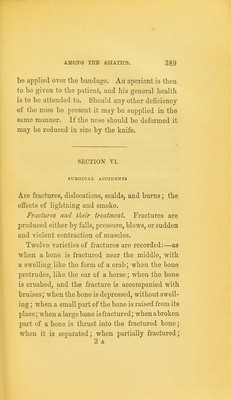
![stopped, and a bandage applied, so as to keep the parts together of the natural figure and shape. The patient should not sleep during the day, nor eat much, but remain in a cool situa- tion, and avoid fatigue. When the part is properly- healed, apply an oleaginous ointment, prepared with wax, oil, and fat. When the parts are healed up the lobe may be pierced, according to custom. If not properly performed, many bad conse- i][uenoes will follow these operations, as indura- tions, swellings, ulcers, &c. The nose may be destroyed by disease; but a much more common cause is its excision, as a punishment, in the native courts of law, in many parts of Asia, When such a deformity is to be restored, a fresh leaf is cut of exactly the size of the nose, it is then to be placed upon the cheek, and the necessary quantity of skin and cellular membrane is to be traced. The remains of the nose are then scarified, and after dissecting up the flap, it is to be placed upon the raw part of the nose, to which it will adhere. Sutures and band- ages are applied to keep the parts together. After the bandage has been applied, a couple of wooden canulae are to be introduced into the nostril to allow breathing, and to support the new nose. A piece of linen cloth previously soaked in oil is to](https://iiif.wellcomecollection.org/image/b24758863_0001_0500.jp2/full/800%2C/0/default.jpg)