The essentials of histology, descriptive and practical, for the use of students.
- Edward Albert Sharpey-Schäfer
- Date:
- 1902
Licence: In copyright
Credit: The essentials of histology, descriptive and practical, for the use of students. Source: Wellcome Collection.
Provider: This material has been provided by Royal College of Physicians, London. The original may be consulted at Royal College of Physicians, London.
23/592 page 7
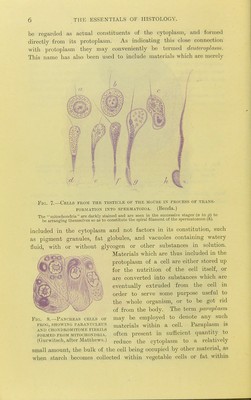
![the cells of adipose tissue. It is frequently the case that the para- plasm and deuteroplasm are confined mainly to the middle of the cell in the neighbourhood of the nucleus, an external zone of the protoplasm being left clear. The two portions of protoplasm which are thus somewhat imperfectly differentiated off from one another are termed respectively the endoplasvi and the exuplasm. They are exhibited in the amcfiba (fig. 2), and also in the white blood- corpuscle (fig. 9). According to the view advocated by Biitschli the apparent reticulum or spongiopliism of a cell is the optical effect of a soft honeycomb or frotli-like structure : in other words, the meshes of the reticulum do not communicate with one another as in a sponge, but are closed cavities as in a lioneycoinb. Butsclili finds indications of the same alveolar sti-ucture in all cells, including Fig. 9.—Photogkaph of leucocyte of triton, fixed whilst in amuiuoid condition by jet of steam directed on to cover-glass, stained WTH HEMATOXYLIN. Magnified 1360 diameters. Untouched photograph. The protoplasm shows an internal granular and reticular endoplasni and a clear exoplasm. nerve-fibres and muscle-fibres, and has devised experiments with cb'ops of froth made up of a mixture of oil and alkaline carbonate or sugar solution, which, when examined in water undei' the microscope, imitate very closely not only the structural appeaiance (fig. 10) but even the so-called spontaneous or amceboid mo\'enients of actual protoplasm. It may be stated, however, that although it is a matter of difficulty trj deteiiuine whether a microscopic reticulum is a sjjongewoi'k or a honeycomb, it is probable that neither structure is essential to living substance, for the outei-most layei' of the cell protoplasm, which is usually the most active in exhibiting movements, often .shows no indication of such sti'ucture. And further, it has been shown by Hardy that a colloid solution such as that which exists in ]Drotoplasm may, under some circumstances, appear homogeneous and under others may .separate out into two parts, one more solid the other more fluid, and after such separation may exhibit either a granular, a I'eticular, or a honeycomb structure, accoiding to circumstances. Nor is a froth nece.ssary for the imitation of am<i.'boid movements, for similar movements, due to changes in surface tension, and brought about in a simple oil drop or in a drop of oil-clad albumen when brought in contact with solution of soa]) or of any alkali (Berthold, Quincke). A drop of any colloid solution containing](https://iiif.wellcomecollection.org/image/b24758462_0023.jp2/full/800%2C/0/default.jpg)




 No text description is available for this image
 No text description is available for this image
 No text description is available for this image