Body and will : being an essay concerning will in its metaphysical, physiological and pathological aspects / by Henry Maudsley.
- Henry Maudsley
- Date:
- 1884
Licence: Public Domain Mark
Credit: Body and will : being an essay concerning will in its metaphysical, physiological and pathological aspects / by Henry Maudsley. Source: Wellcome Collection.
Provider: This material has been provided by King’s College London. The original may be consulted at King’s College London.
49/350 page 37
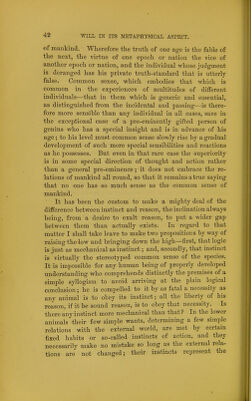
![objects througli the senses. The latter knowledge is after all just as immediate in itself, since it consists actually of states of consciousness. When I perceive an object it manifestly is not the object that is known to me directly, but the state of con- sciousness: the odour is not in the rose, but in the rose- smeller ; the colour is not in the flower, but in the flower- seer ; the harmony of fine sound is not in the instrument, but in the sensibilities of him who hears it, existing not for him who has no ear for music: the external conditions of colour, odour and sound are not in the least like the sensations which they excite. Whatever it be mediate of, however, the state of consciousness is itself immediate. In like manner, the knowledge of those states of conscious- ness which are described as immediate—the Descartian cogito, for example, which is to convince me that I am—is without doubt immediate in itseK, but it is none the less mediate of something of which it is an afiTection; and this something, if we suppose it to be a mental self, is far more difficult to know in itself than the external object, being no more than it within the compass of introspective intuition, and, unlike it, not being wdthin the compass of objective observation. A state of consciousness that is at all definite, whether of internal or external origin, cannot certainly be either the subjective or the objective thing in itself: it is a relation of self and not-self, and implicates the one as necessarily as the other term. Cogito, ergo sum, ' I think, therefore I am,' has a ring of transcendental author- ity, until we interpolate after ' I' the quietly suppressed but none the less surreptitiously understood ' who am,' and let it read, as it should read, thus—' I [who am] think, there- fore I am;' after which it does not appear to carry us beyond the simple and subjectively irreducible fact of con- sciousness, beneath which, it must not be forgotten, there is in all cases the more fundamental fact of an organism that is one. To assert that th.e feeling of which we have direct ex- perience is not bodily but mental, is to make two statements which are not self-evident, and which certainly cannot be](https://iiif.wellcomecollection.org/image/b21293090_0049.jp2/full/800%2C/0/default.jpg)