Licence: Public Domain Mark
Credit: The student's guide to medical diagnosis / by Samuel Fenwick. Source: Wellcome Collection.
Provider: This material has been provided by the Royal College of Physicians of Edinburgh. The original may be consulted at the Royal College of Physicians of Edinburgh.
86/200 page 66
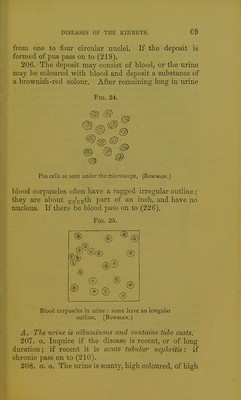
![194. The symptoms that should lead you to suspect disease of the kidneys are, anajmia, dropsy, vomiting in the early morning, frequent attacks of bronchitis, diarrhoea, dyspepsia, or convulsions. Indeed, as most of the diseases of this organ are unaccompanied by pain, it will be advisable for you to ascertain the state of the kidneys in any case in ivhich the symptoms are obscure or threatening. The urine supplies you with the best means of determining if the kidney is healthy; you should therefore practise yoiu-seh in the examination of it as carefully as in auscultation and percussion. ] 95. Observe the colour of the urine, whether it is of lighter or darker tint than usual, or if it is tinged with blood or bile. 196. Ascertain its specific gravity; float in it a lu-inometer, and observe what number on the scale is on a level with the upper surface of the liquid. The urinometer is so constructed that it floats with the index at zero when placed in distilled water. The specific gravity of healthy urine is from 1015 to 1025. 197. Test for the presence of albumen; boil a small portion of urinp in a test-tube, and add a few drops of nitric acid. If albumen is present the fluid becomes opaque. Observe the proportion of albumen when it has fallen to the bottom of the tube; as, for instance, about one-quarter or one-sixth of the liquid examined. If you find albumen, begin at (200). 198. If you do not find albumen, next test for sugar. Pour into a test-tube a small quantity of the urine, add to it a few di-ops of a dilute solution of sulphate of copper, and about half as much liquor potassiB as urine, and boil the mixture; if sugar be present a reddish- brown precipitate of suboxide of copper will be deposited. If you find this, pass on to (238). 199. Although neither albumen nor sugar be present, you may still derive much information fi-om a further examination of the urine ; pour a portion of it into a conical glass, and pass on to (243).](https://iiif.wellcomecollection.org/image/b21977938_0086.jp2/full/800%2C/0/default.jpg)


 No text description is available for this image
 No text description is available for this image
 No text description is available for this image