The constituents of the flowers of Trifolium incarnatum / by Harold Rogerson.
- Rogerson, Harold.
- Date:
- [1910?]
Licence: In copyright
Credit: The constituents of the flowers of Trifolium incarnatum / by Harold Rogerson. Source: Wellcome Collection.
14/16 page 1015
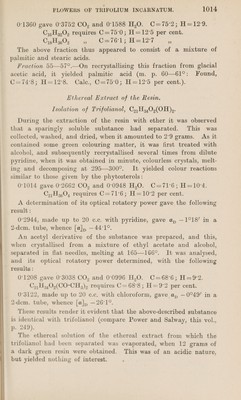
![I Chloroform, Ethyl Acetate, and Alcohol Extracts of the Resin. These extracts were dark-coloured resins, amounting to 5, 2*5, and 8'3 grams respectively. They were thoroughly examined, but nothing definite could be isolated from them. Summary. The results of this investigation may be briefly summarised as follows: The material employed consisted of the dried flowering tops of the carnation clover (Trifolium incarnatum, Linne). An alcoholic extract of this material, when distilled with steam, yielded an essential oil in an amount equivalent to 0'029 per cent, of the dried flowers. This essential oil, which contained furfuraldehyde, pos¬ sessed a strong persistent odour, and the following constants : d 20°/20° = 0'9597; aD —1°48/ in a 1-dcm. tube. The portion of the alcoholic extract which was soluble in water contained a considerable quantity of a sugar which yielded f/-phenyl- glucosazone (m. p. 205—206°), and from the aqueous liquid the following definite substances were isolated: benzoic and salicylic acids, in very small amount, with apparently a trace of ^-coumaric acid; pratol, C16H1204; quercetin, C15H10O7, and a new glucoside of the latter, C21H20O12,3H2O (m. p. 242—245°), which has been designated incarnatrin. The portion of the alcoholic extract which was insoluble in water consisted chiefly of green, resinous material, the amount of which was equivalent to 4’1 per cent, of the weight of the dried flowers. From this resin the following compounds were obtained : an alcohol, C34HC9-OH (m. p. 72—74°), which had previously been obtained from the wax of the humble-bee, and which it is now proposed to designate incarnatyl alcohol; hentriacontane, C31H04; a phytosterol, C27H460 (m. p. 135—136°; [a]D —41‘7°), which yields an acetyl derivative melting at 124—125°, and having [a]D — 43‘9°; tri- folianol, C21H3402(0H)2 (m. p. 295—300°; [a]D — 44*1°), and a mixture of fatty acids, consisting chiefly of palmitic, stearic, and linolic acids, with smaller amounts of oleic and fsolinolenic acids. In conclusion, the author wishes to express his indebtedness to Dr. F. B. Power for having suggested this research, and for the kind interest he has shown throughout the course of the work. The Wellcome Chemical Research Laboratories, London, E.C, R, f'LAV AND SONS, LTD,, Hit J£A D ST- HILL, E.O., AND BUNGAY SUKLOL^](https://iiif.wellcomecollection.org/image/b30616803_0014.jp2/full/800%2C/0/default.jpg)


 No text description is available for this image
 No text description is available for this image
 No text description is available for this image